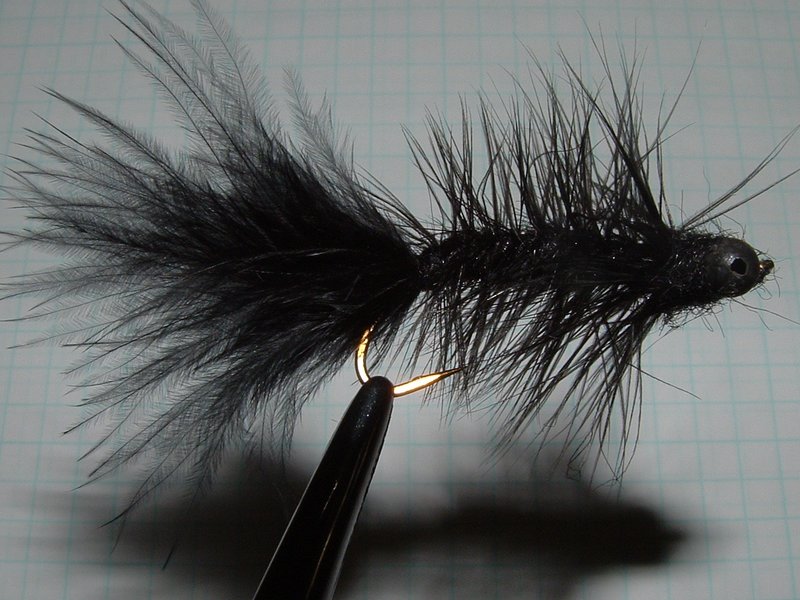
Black Woolly Bugger
The Black Woolly Bugger stands as arguably the most versatile and universally effective fly pattern ever created. This simple yet deadly streamer imitates leeches, baitfish, sculpins, crayfish, and large aquatic insects—essentially anything meaty that trout, bass, and other gamefish feed on. If forced to fish with only one fly for the rest of their lives, countless anglers would choose the Black Woolly Bugger without hesitation. The pattern's effectiveness comes from its lifelike movement in the water. The soft marabou tail undulates with even the slightest current, creating the illusion of a living creature swimming or struggling. The palmered hackle along the body adds additional movement while creating a buggy, substantial silhouette. When stripped through the water, the Woolly Bugger pulses and breathes like prey, triggering aggressive strikes from predatory fish. Black is the classic color and often the most productive, especially in off-color water, low light conditions, or when imitating leeches. The pattern excels in fall and winter when trout become more aggressive and feed heavily on larger prey items to build reserves. It works in every water type imaginable—from tiny mountain brooks where size 8 versions take wild trout, to large tailwaters and reservoirs where size 4 monsters draw crushing strikes from trophy fish. Fishing techniques vary widely: dead-drift it like a nymph through deep runs, strip it erratically like a fleeing baitfish, swing it on a tight line through pools, or even skate it across the surface. The Woolly Bugger produces at all depths and speeds, making it the ultimate searching pattern when you're uncertain what fish are feeding on or where they're holding.
Pattern Details
- Type
- Streamer
- Seasons
- fall, winter
- Hook Sizes
- #4-8
- Hook Type
- 3X or 4X long streamer hook
- Tying Difficulty
- Beginner
- Imitates
- Leech, baitfish
Recipe & Materials
- Hook
- Tiemco 5263 or equivalent 3X-4X long streamer hook, sizes 4-8
- Thread
- 6/0 black
- Tail
- Black marabou
- Body
- Black chenille, medium
- Hackle
- Black saddle hackle, palmered
- Weight
- Lead or non-lead wire (optional), or bead head
- Rib
- Fine copper or gold wire (optional, for durability)
Technique & Presentation
The Woolly Bugger is often the first streamer pattern new tyers learn, and for good reason—it's nearly impossible to tie incorrectly. For weighted versions, start by wrapping 15-20 turns of lead or lead-free wire around the middle of the hook shank. Build a thread base over the wire, tapering at both ends to create a smooth foundation.
Tie in a marabou tail at the bend, approximately one shank length long. The tail should be full and fluffy—don't skimp on marabou. At the same point, tie in a black saddle hackle by the tip and the chenille. If using wire ribbing for durability, tie it in now as well. Wrap the chenille forward in touching turns to create a thick, uniform body, stopping just behind the hook eye.
Now palmer the hackle forward in evenly-spaced spirals over the chenille body, creating 4-6 wraps total. If using wire ribbing, counter-wrap it through the hackle to lock everything in place and add durability. The hackle should be somewhat sparse—you should be able to see the chenille body between wraps. Tie off the hackle, build a neat head, whip finish, and apply head cement. For extra flash and weight, many tyers add a gold or black tungsten bead head before starting the pattern.
History & Origin
The Woolly Bugger evolved from the Woolly Worm, a traditional pattern that dates back to the early 20th century. In 1967, Pennsylvania fly fisher Russell Blessing modified the Woolly Worm by adding a marabou tail, creating what would become the Woolly Bugger. Blessing developed the pattern while fishing Pennsylvania's limestone streams for bass and panfish, but quickly discovered its effectiveness on trout as well.
The name 'Bugger' is believed to derive from the British term for large, ugly flies, though some suggest it references the pattern's resemblance to a dobsonfly larva (hellgrammite), also called a 'bugger' in some regions. Regardless of etymology, the name proved prophetic—the Woolly Bugger has 'bugged' more fish than perhaps any other pattern in fly fishing history.
From its Pennsylvania origins, the Woolly Bugger spread rapidly throughout North America in the 1970s and 1980s, as anglers discovered its effectiveness on virtually every gamefish species. It became a commercial success, with Umpqua Feather Merchants reporting it as their best-selling pattern for decades. Today, the Woolly Bugger exists in hundreds of color variations—olive, white, purple, brown—but the original black version remains the standard. Russell Blessing's simple modification of a traditional pattern created a modern classic that will undoubtedly catch fish for generations to come.
Related Streamer Patterns
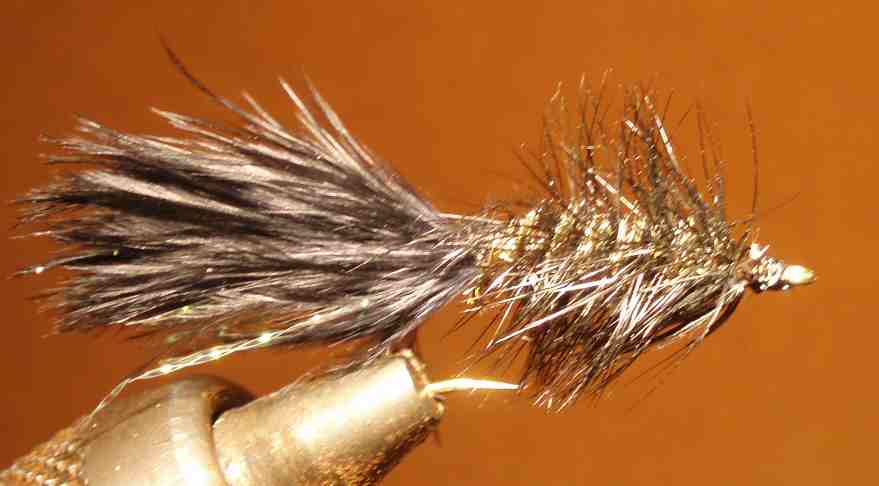
Woolly Bugger
If you could only fish one fly for the rest of your life, many guides would choose the Woolly Bugger. It imitates leeches, baitfish, crayfish, and large nymphs. Strip it, swing it, dead-drift it; the Woolly Bugger catches fish everywhere. The Woolly Bugger is the Swiss Army knife of fly fishing. Its marabou tail undulates seductively with the slightest current or rod-tip movement, its palmered hackle body creates a buggy, lifelike profile, and its overall shape suggests a wide range of aquatic prey items. Whether a trout sees it as a leech, a sculpin, a crayfish, a large stonefly nymph, or a small baitfish, the result is the same: they eat it. The Woolly Bugger is effective in still water and moving water, in clear conditions and dirty water, in winter and summer. In Montana, the Woolly Bugger is the pattern you tie on when nothing else is working, or when everything is working and you want to catch bigger fish. A black Woolly Bugger stripped along the banks of the Madison or Yellowstone will draw strikes from brown trout that ignore all other offerings. Olive and brown versions excel on tailwaters. White Woolly Buggers fished deep on sinking lines can produce the largest fish of the day. No Montana fly box is complete without a selection of Woolly Buggers in black, olive, brown, and white, in sizes #4 through #10.
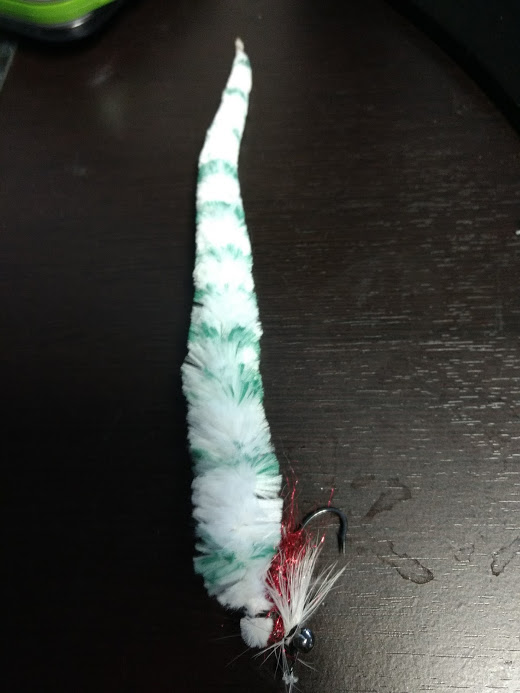
Sculpzilla
A simple sculpin imitation that swims with an enticing undulating action. The Sculpzilla is less flashy than articulated streamers but deadly effective. Fish it on a short-line swing or strip it along the banks for aggressive brown trout. The Sculpzilla is a masterclass in effective simplicity. While the streamer world has trended toward ever-larger, ever-more-complex articulated patterns, the Sculpzilla proves that a well-designed single-hook fly can be just as effective. The pattern uses a minimal number of materials (primarily a wool head and marabou or rabbit strip body) to create a sculpin profile that rides hook-point-up and swims with a natural, undulating motion that perfectly mimics a sculpin darting along the bottom. Sculpins are a critical forage species in Montana's trout rivers. These bottom-dwelling baitfish are found in every stream and river in the state, and they are a preferred food item for large brown trout. The Sculpzilla's hook-up design allows it to be bounced along rocky bottoms without snagging, putting it right in the zone where sculpins live. On the Madison, Yellowstone, and Missouri rivers, the Sculpzilla consistently produces large trout that have learned to associate the sculpin silhouette with an easy, protein-rich meal.
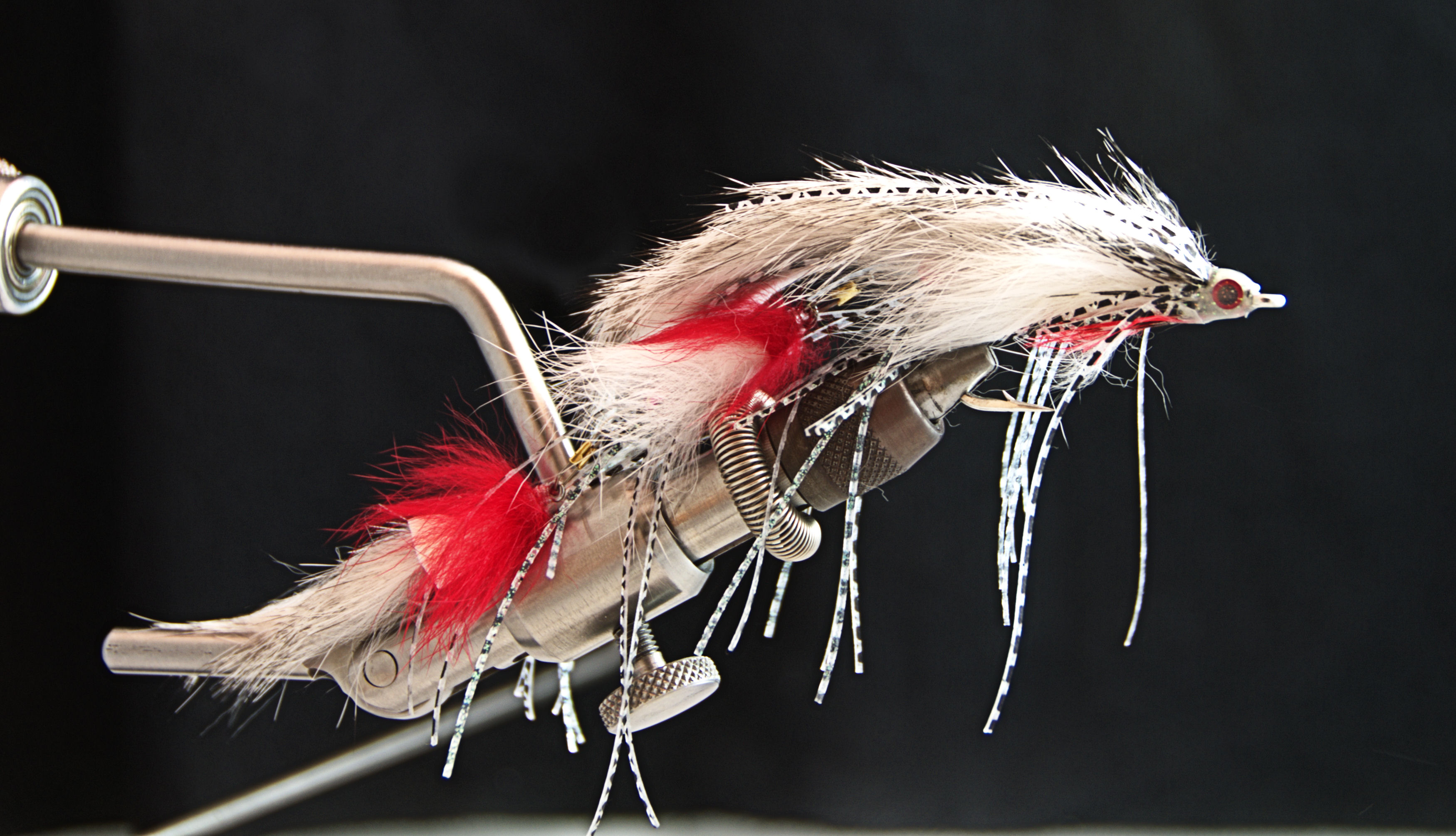
Sex Dungeon
Kelly Galloup's articulated streamer is designed to provoke territorial aggression from large brown trout. This big, flashy fly pushes water and triggers reaction strikes. Fish it on sinking tips along cut banks and boulder structure. The Sex Dungeon is not designed to be eaten; it is designed to be attacked. Kelly Galloup, the master of the modern streamer game, created this pattern specifically to trigger the territorial aggression of large brown trout. With its articulated body, marabou tail, flash-infused profile, and pulsating materials, the Sex Dungeon pushes water and creates a commotion that demands a response from any predatory fish in the vicinity. The fly does not need to closely match any specific baitfish; it needs to intrude on a trout's territory and provoke a violent reaction. Fishing the Sex Dungeon is a fundamentally different experience from nymph or dry fly fishing. You are hunting, not waiting. You are casting to specific pieces of structure (undercut banks, logjams, boulder gardens, deep slots) where large trout establish territories. The strike, when it comes, is explosive: a flash of brown and gold, a savage pull, and the fight of a lifetime. On Montana's premier brown trout rivers (the Madison, the Yellowstone below Livingston, and the lower Missouri) the Sex Dungeon is the pattern that unlocks access to the biggest fish in the river.
Zuddler
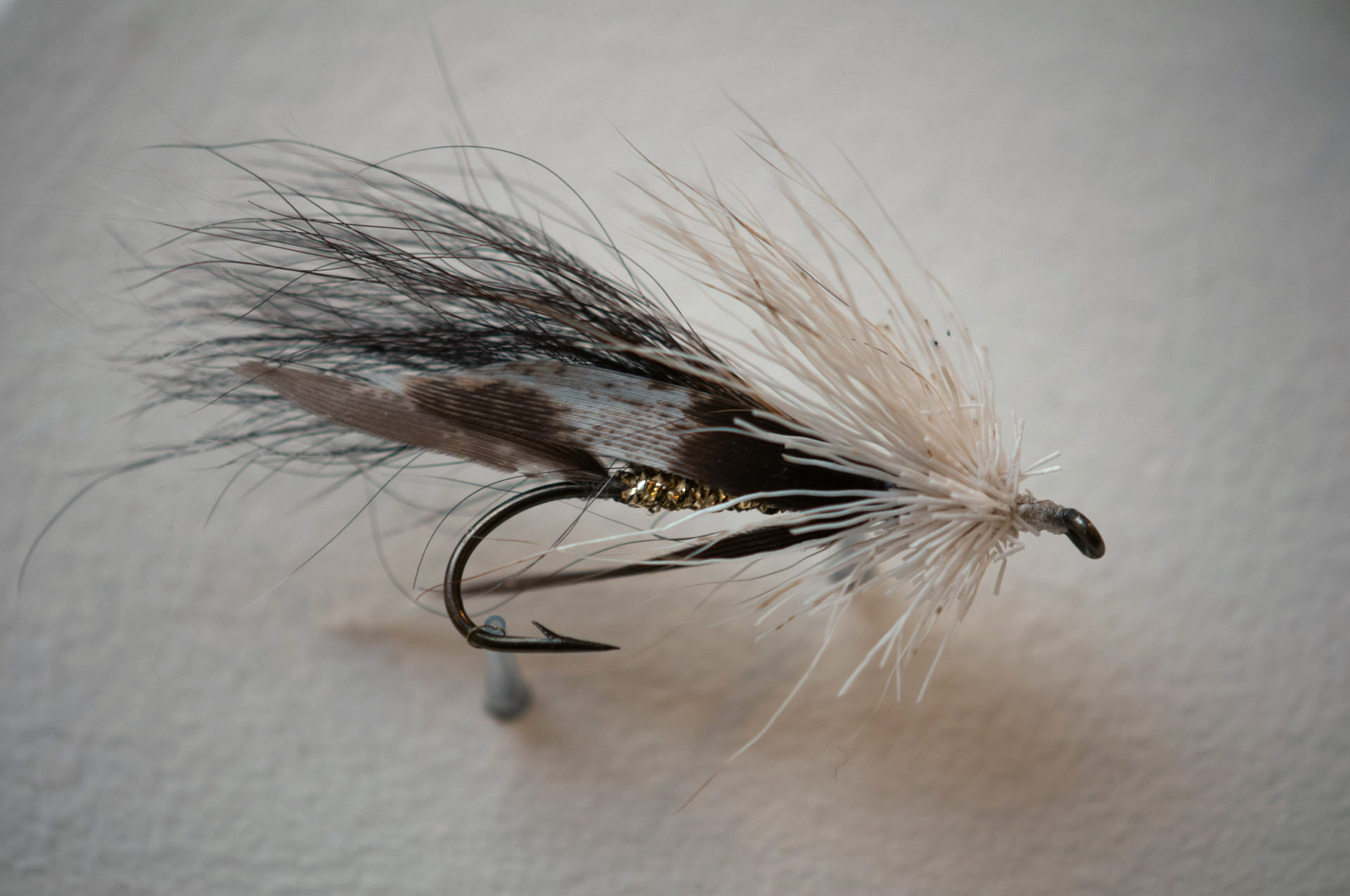
A versatile sculpin-meets-Muddler pattern that works fished slow or fast, deep or shallow. The spun deer hair head creates surface disturbance when stripped and can be dead-drifted like a large nymph. The Zuddler occupies a unique niche in the streamer world as a fly that can be fished effectively at virtually any speed and depth. Its spun and clipped deer hair head, borrowed from the classic Muddler Minnow, gives it buoyancy and creates a water-pushing action when stripped. Below the head, a zonker strip body and marabou tail provide the movement and lifelike action of modern streamer designs. This combination of old-school and new-school elements makes the Zuddler one of the most versatile streamers available. The Zuddler's versatility is its greatest asset on Montana rivers. Fish it with an aggressive strip on a floating line to create a wake that draws explosive surface strikes. Fish it on a sink-tip with a slow retrieve to work it through deeper structure. Dead-drift it through a run like an oversized nymph for trout that are not in an aggressive mood. This ability to adapt to conditions and fish mood makes the Zuddler an excellent choice when you are not sure what the fish want. On the Madison and Yellowstone, where conditions can change throughout the day, having a fly that adjusts with you is invaluable.
Egg Sucking Leech
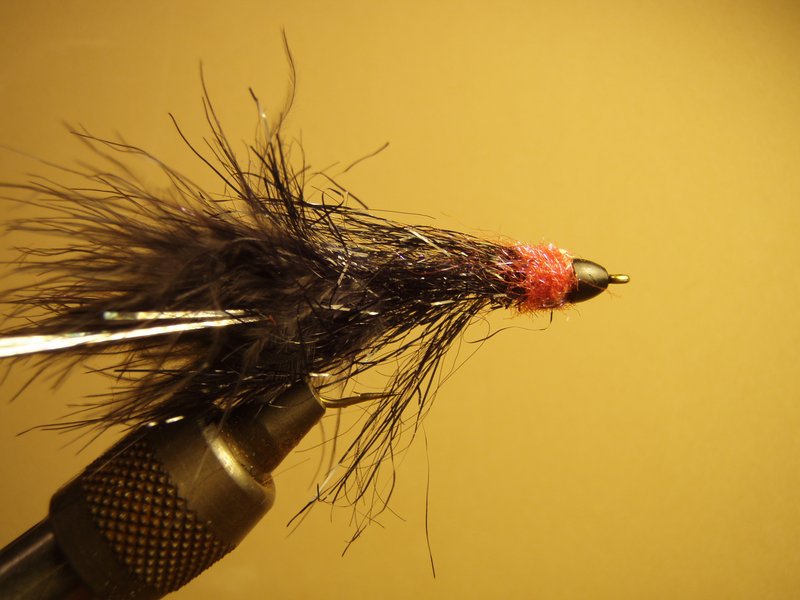
The Egg Sucking Leech is an audacious pattern that combines two of the most effective subsurface offerings in one fly: a leech imitation and an egg. This Alaskan-born pattern was designed to target aggressive rainbow trout and char feeding in spawning areas, but has proven deadly across the continent for any trout species. The garish combination of a dark leech body with a bright orange or pink bead head creates an irresistible target that triggers both predatory and egg-feeding instincts. Despite its somewhat comical name, the Egg Sucking leech represents a real feeding behavior. During salmon and trout spawning periods, leeches are attracted to spawning redds where they feed on dislodged eggs. Trout quickly learn that a dark, undulating shape near spawning areas often means an easy meal of both the leech and any egg it might be consuming. The pattern capitalizes on this association, presenting both food sources in one package. The fly works exceptionally well during fall, winter, and spring when various salmonid species are spawning. In rivers with fall salmon runs or spring rainbow spawns, the Egg Sucking Leech can be absolutely devastating. It's equally effective in tailwaters below dams year-round, where spawning activities occur throughout the seasons. The pattern also produces well in non-spawning periods simply as an attractor pattern, with the bright bead drawing attention in murky or deep water. This pattern has proven effective from Alaska's salmon streams to Montana's freestone rivers, Wyoming's tailwaters, Idaho's spring creeks, and throughout the Pacific Northwest. It works in Colorado's Gold Medal waters, California's Sierra streams, and even eastern waters like Pennsylvania's steelhead streams. The Egg Sucking Leech is particularly valuable in early season or high water conditions when visibility is reduced and trout respond to bold, visible flies. Fish it on a dead drift through deep runs, swing it through pools, or strip it erratically to imitate a fleeing leech.
Grey Ghost
The Grey Ghost is a legendary Maine streamer pattern created specifically to imitate smelt, the primary baitfish in many New England trout and landlocked salmon waters. This elegant feather-wing streamer features a silver body, distinctive orange belly, and graceful layered wings that create a remarkably lifelike swimming action. The pattern represents the pinnacle of traditional New England streamer design, where artistry and effectiveness combine to create flies that are as beautiful as they are deadly. Smelt are anadromous baitfish that spend most of their lives in lakes or the ocean, running up tributary streams to spawn in early spring. In Maine's landlocked salmon waters and throughout New England's cold lakes, smelt constitute the primary forage for large predatory fish. The Grey Ghost's design captures the smelt's silvery flanks, orange-tinged belly, and slender profile, making it irresistible to hungry trout and salmon searching for a substantial meal. The pattern excels when fished in Maine's famous landlocked salmon lakes like Sebago, Moosehead, and the Rangeley Lakes chain. It's equally effective in other New England waters including New Hampshire's Lake Winnipesaukee, Vermont's Lake Champlain, and throughout the Adirondacks. While designed for Eastern waters, the Grey Ghost has proven effective wherever trout feed on silvery baitfish, including Western tailwaters and reservoirs. The fly works best when retrieved with a slow, undulating motion that mimics an injured or fleeing smelt. Traditionally tied in sizes 2-6 for landlocked salmon and large brook trout, the Grey Ghost can be scaled down to size 8-10 for stream fishing or scaled up to size 1/0 for saltwater use. The pattern is most productive from ice-out through early summer when smelt are running and again in fall when baitfish concentrate. Fish it on a floating line with a slow retrieve in shallow water, or use a sink-tip line to probe deeper haunts where large fish cruise.