Apache Trout
Oncorhynchus apache
Overview
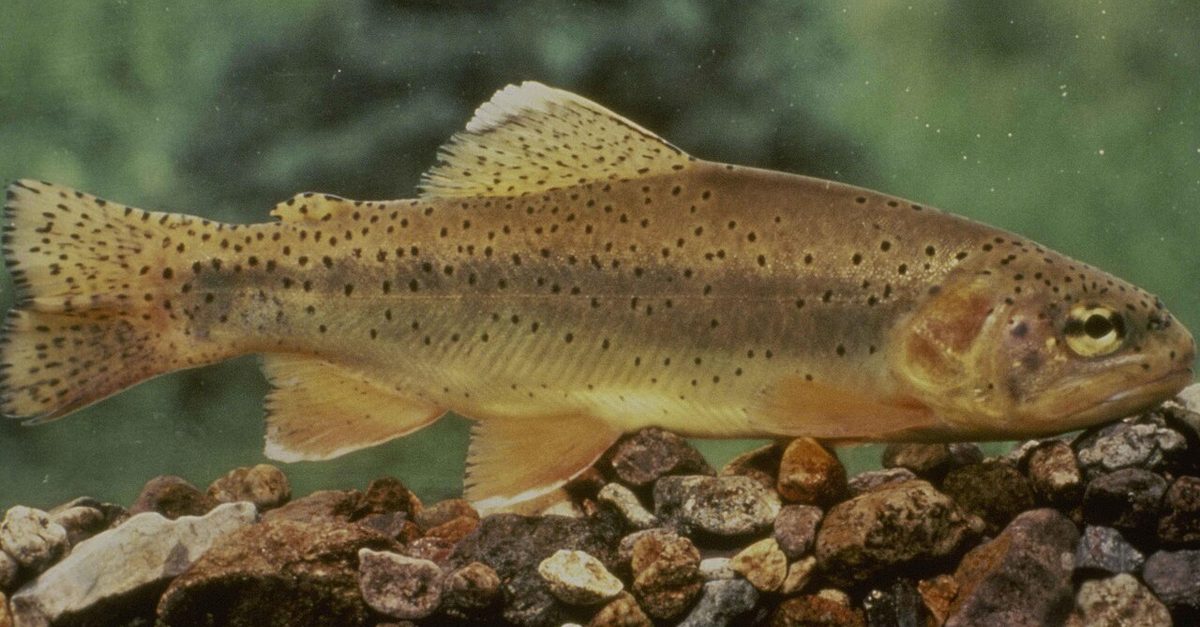
The Apache trout is Arizona's official state fish and one of only two trout species native to the state, found nowhere else in the world except the headwater streams and lakes of the White Mountains in east-central Arizona. This golden-hued trout evolved in isolation in the upper Salt River and Little Colorado River drainages on the slopes of Mount Baldy, the sacred peak of the White Mountain Apache people, adapting to the cold, clear mountain streams at elevations above 7,000 feet. The Apache trout's beauty is unmistakable: a warm golden-yellow body overlaid with widely spaced, large dark spots, dark dorsal and caudal fin markings that give it a distinctive spotted-fin appearance, and a golden-olive back.
Once one of the first fish listed under the Endangered Species Act in 1967, the Apache trout has been the focus of one of the most successful native trout recovery programs in the United States. Through decades of work by the U.S. Fish and Wildlife Service, Arizona Game and Fish Department, the White Mountain Apache Tribe, and the Apache-Sitgreaves National Forests, the subspecies was downlisted from Endangered to Threatened in 2006. Recovery efforts have included removing non-native trout from headwater streams, constructing fish barriers to prevent reinvasion, and establishing new populations through careful translocations.
For fly anglers, catching an Apache trout is a bucket-list experience that combines rare native trout fishing with the stunning scenery of the White Mountains. Apache trout are eager surface feeders that respond aggressively to dry flies, making them a joy to catch on light tackle. The East Fork and West Fork of the Black River, stocked with Apache trout by Arizona Game and Fish, offer the most accessible fishing, while streams on the White Mountain Apache Reservation require a tribal permit and provide a more remote and culturally significant experience.
Identification
Apache trout are among the most visually distinctive trout in North America, making field identification relatively straightforward in their native range. The most prominent feature is the overall golden-yellow body coloration, which is warmer and more intensely yellow than any other trout species in Arizona. The back is olive-gold, transitioning to bright golden-yellow flanks and a pale yellowish-white belly. During spawning season, the golden coloration intensifies and may develop an orange or coppery tint.
The spotting pattern is diagnostic: Apache trout have relatively large, dark, irregularly shaped spots that are evenly distributed across the body and, critically, extend onto the dorsal and caudal (tail) fins. This fin spotting, combined with a distinct dark band along the top of each fin, gives the dorsal fin a two-toned appearance that is unique among Arizona trout. The spots are larger and more widely spaced than those of rainbow trout, and they extend above and below the lateral line.
Two additional field marks help confirm identification. First, Apache trout have a distinctive dark eye stripe, a horizontal dark band that extends through the pupil and behind the eye, giving the fish a masked appearance. Second, the cutthroat-like marks beneath the jaw are typically faint yellow or golden rather than the vivid red-orange of true cutthroat trout. In waters where Apache trout coexist with non-native rainbow trout, hybrid fish may display intermediate characteristics; genetic testing is the only definitive method for confirming pure Apache trout lineage in such situations.
Diet
Apache trout are opportunistic feeders whose diet reflects the relatively simple food webs of their high-elevation mountain stream habitat. Aquatic insects form the bulk of their diet, including mayfly nymphs (particularly small Baetis species), caddisfly larvae, midge larvae and pupae, and small stonefly nymphs. The headwater streams where Apache trout reside tend to have less insect diversity than larger valley rivers, but the insects that are present occur in sufficient density to support healthy trout populations.
Terrestrial insects become increasingly important during the warm months from June through September. Ants, beetles, grasshoppers, and other insects that fall from the streamside vegetation into the water provide a significant caloric supplement, particularly in the small, canopy-covered streams that typify Apache trout habitat. This terrestrial dependence makes mid-summer an excellent time to fish attractor dry flies and small terrestrial patterns.
Apache trout rarely become piscivorous even at larger sizes, remaining committed invertebrate feeders throughout their lives. In lakes and reservoirs on the White Mountain Apache Reservation where conditions allow greater growth, Apache trout may supplement their insect diet with zooplankton and small crustaceans, but they never develop the predatory fish-eating habits of larger salmonid species. Their willingness to feed on surface insects makes them among the most cooperative dry-fly trout in the Southwest.
Habitat Preferences
Apache trout require cold, clean mountain streams at elevations above 7,000 feet in the White Mountains of east-central Arizona. Their optimal water temperature range is 45 to 55 degrees Fahrenheit, and they are found in streams with intact riparian corridors, clear gravel substrates for spawning, and minimal sedimentation. The streams they inhabit are typically small (5 to 15 feet wide), steep-gradient headwater creeks with plunge pools, pocket water, and dense conifer or mixed-conifer forest canopy that provides shade and terrestrial insect input.
Historically, Apache trout occupied approximately 600 miles of stream in the upper Salt River and Little Colorado River drainages. Today, genetically pure populations persist in approximately 30 streams, many of which are protected by fish barriers that prevent upstream migration of non-native rainbow and brown trout. The primary threats to Apache trout habitat include hybridization with non-native rainbow trout (the species' greatest long-term threat), competition from brook trout and brown trout, habitat degradation from livestock grazing, wildfire impacts, and climate change that may push suitable habitat to ever-higher and smaller stream reaches.
Spawning occurs in spring, typically from March through June depending on elevation and water temperature. Apache trout select clean gravel in moderate-current runs for redd construction, and eggs incubate for 4 to 6 weeks. The slow growth rate of fish in these cold, nutrient-limited streams means that Apache trout require several years to reach maturity, making population recovery slow after disturbance events like wildfire or drought.
Fishing Tactics
Apache trout are among the most willing surface feeders in the trout family, making dry fly fishing the preferred and most productive technique. Small attractor patterns are the standard offerings: Parachute Adams, Elk Hair Caddis, Royal Wulffs, Humpies, and Yellow Stimulators in sizes 12 through 16 cover nearly every situation on Apache trout water. The small mountain streams where these fish reside demand short, accurate casts, and a 7- to 8-foot rod in 3- or 4-weight is ideal. Keep leaders short (7.5 to 9 feet tapered to 4X or 5X) and focus on placing your fly precisely into pocket water, plunge pools, and along undercut banks.
Terrestrial patterns are devastatingly effective from mid-June through September. Small foam beetles in sizes 14 to 16, ant patterns in sizes 16 to 18, and miniature hopper imitations work exceptionally well when cast tight to overhanging banks and under low-hanging branches. A hopper-dropper rig with a small foam dry fly on top and a beadhead Pheasant Tail or Prince Nymph trailing 12 to 16 inches below provides versatility for prospecting.
Apache trout streams are typically very small and overgrown, requiring stealth and careful approach. Stay low, avoid casting shadows over the water, and approach each pool from downstream. Because these fish are part of a conservation success story, practice careful catch-and-release: use barbless hooks, handle fish briefly in the water, and release them at the point of capture. A free Gila Trout/Apache Trout fishing permit from Arizona Game and Fish may be required on certain waters; always check current regulations before fishing.
Conservation
The Apache trout is listed as Threatened under the Endangered Species Act, downlisted from Endangered in 2006 following significant recovery progress. The Apache Trout Recovery Plan establishes the goal of maintaining at least 30 self-sustaining populations of genetically pure Apache trout across their historic range. As of the mid-2020s, approximately 30 populations exist in protected headwater streams, with ongoing work to establish additional populations through non-native fish removal and barrier construction. The Apache Trout Recovery Team, a partnership between federal agencies, the State of Arizona, the White Mountain Apache Tribe, and conservation organizations, has achieved remarkable success in restoring this species from the brink of extinction. Key conservation strategies include piscicide treatments to remove non-native trout from target streams, construction of migration barriers to prevent reinvasion, genetic monitoring to ensure population purity, and habitat restoration through improved grazing management and riparian fencing. The White Mountain Apache Tribe has been a critical partner, managing Apache trout populations on tribal lands and allowing limited recreational fishing that generates support for conservation. Anglers contribute to Apache trout conservation through permit fees, catch-and-release practices, and advocacy for habitat protection. Arizona Game and Fish stocks catchable Apache trout in select streams on National Forest land from May through September, providing anglers with opportunities to catch this rare native species without impacting the genetically pure recovery populations. Fishing for Apache trout in their native mountain streams is both a recreational privilege and a conservation success story.
Rivers Where Found
Quick Facts
- Scientific Name
- Oncorhynchus apache
- Average Size
- 8-12"
- Trophy Size
- 16+"
- State Record
- 5 lbs 15.5 oz, caught in Christmas Tree Lake on the White Mountain Apache Reservation in 1993
- Found In
- East Fork Black River