Yellowstone Cutthroat Trout
Oncorhynchus clarkii bouvieri
Overview
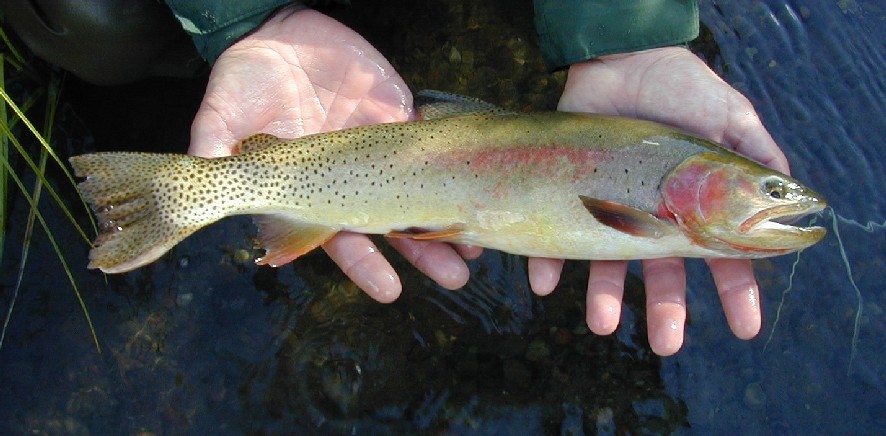
The Yellowstone cutthroat trout is Montana's most iconic native fish, a living symbol of the wild, untrammeled waters of the Greater Yellowstone Ecosystem. This subspecies of cutthroat trout evolved in the Yellowstone River drainage over thousands of years and is uniquely adapted to the cold, clear streams and rivers of south-central Montana. Named for the vivid red-orange slash marks beneath its lower jaw, the 'cut throat' that gives the entire cutthroat species complex its name, the Yellowstone cutthroat is one of the most beautiful and culturally significant fish in the American West.
Yellowstone cutthroats are generally considered the most eager surface feeders among Montana's trout species, making them a favorite among dry-fly purists. They tend to be less wary than brown trout and more willing to eat a well-presented dry fly, even when no hatch is occurring. On their home waters (the Yellowstone River above Livingston, Slough Creek in Yellowstone National Park, the upper Lamar River, and numerous tributary streams throughout the Absaroka and Beartooth ranges), cutthroats will rise freely to attractor dry flies like Royal Wulffs, Stimulators, and Elk Hair Caddis, providing the kind of classic western dry-fly experience that anglers travel thousands of miles to enjoy.
Despite their eagerness at the end of a fly line, Yellowstone cutthroat trout face significant conservation challenges. Habitat loss, hybridization with introduced rainbow trout, competition from non-native brook trout and lake trout, and the impacts of whirling disease have reduced their historic range by roughly 60 percent. Montana Fish, Wildlife & Parks, along with federal agencies and conservation groups, has invested heavily in cutthroat restoration projects, including barrier construction to prevent upstream migration of non-native species and targeted removal of lake trout from Yellowstone Lake. Anglers play an important role in cutthroat conservation by practicing careful catch-and-release techniques and supporting habitat protection efforts.
Identification
The most distinctive identification feature of the Yellowstone cutthroat trout is the pair of vivid red-orange slash marks on the underside of the lower jaw, in the fold of the gill membrane. These 'cutthroat' marks are present on all subspecies of cutthroat trout, but they are particularly bold and bright on Yellowstone cutthroats. No other trout species in Montana carries these markings (though hybrid 'cutbow' fish may show faint slashes).
The body coloration of Yellowstone cutthroats is variable but typically features a yellowish-gold to olive-green back and flanks with a golden or brassy hue, especially in stream-resident fish. Spots are medium-sized, round, and black, concentrated most heavily toward the tail and posterior portion of the body, a pattern that distinguishes the Yellowstone subspecies from the westslope cutthroat (Oncorhynchus clarkii lewisi), which tends to have smaller, more irregularly shaped spots concentrated above the lateral line. Yellowstone cutthroats often display a faint pink or rose flush along the lateral line, particularly during spawning season.
To distinguish Yellowstone cutthroats from rainbow trout, which overlap in many Montana waters, look for the jaw slashes (absent in rainbows) and the spot distribution pattern. Rainbows have spots distributed more evenly across the entire body and heavily on the tail, while cutthroat spots are concentrated posteriorly. Cutthroats also possess small basibranchial teeth on the back of the tongue, a definitive but hard-to-check field mark. Where hybridization with rainbows has occurred, fish may display intermediate characteristics ('cutbows'), making identification challenging. Genetic testing is the only definitive method for identifying pure-strain Yellowstone cutthroats in hybrid zones.
Diet
Yellowstone cutthroat trout feed primarily on aquatic insects, and they are among the most enthusiastic surface feeders of any trout species in Montana. Mayflies are a staple of their diet, including Pale Morning Duns, Green Drakes, Flavs (Drunella flavilinea), Mahogany Duns, and the tiny but prolific Baetis species that hatch throughout the season. Caddisflies, stoneflies (including the massive salmonflies and golden stoneflies), and midges round out the insect portion of their diet. Cutthroats tend to be less selective than brown trout during a hatch, and they will often take a slightly oversized or imperfect imitation that a brown would refuse.
Subsurface feeding on nymphs and larvae accounts for a significant portion of the cutthroat's diet, particularly early in the season before major hatches begin and during periods between hatches. Cutthroats forage along the bottom of pools and runs, picking off stonefly nymphs, mayfly larvae, and caddis pupae as they drift in the current. In lakes and stillwaters, cutthroats also feed on zooplankton, leeches, and freshwater shrimp.
Terrestrial insects become an important food source for Yellowstone cutthroats during summer and early fall. Grasshoppers, beetles, ants, and spruce moths that fall into the water from overhanging vegetation are eagerly consumed, and hopper-dropper rigs can be devastatingly effective on cutthroat streams from July through September. Larger cutthroats will occasionally eat small fish, but they are far less piscivorous than brown trout and remain predominantly insect feeders throughout their lives.
Habitat Preferences
Yellowstone cutthroat trout are cold-water specialists that require clean, well-oxygenated streams with water temperatures below 64 degrees Fahrenheit for optimal health. They are most abundant in mid- to high-elevation streams and rivers throughout the Yellowstone River drainage, from the headwaters in Yellowstone National Park downstream through the Paradise Valley and into the tributaries of the upper Yellowstone. They are also found in several high mountain lakes throughout the Absaroka-Beartooth Wilderness and surrounding ranges.
Preferred cutthroat habitat features moderate current with clean gravel and cobble substrate, which the fish require for spring spawning. Unlike brown trout, which favor deep pools and heavy structure, cutthroats are often found in shallower water, in riffles, pocket water, and the heads and tails of runs where they can efficiently intercept drifting insects. They tend to hold in less complex lies than browns, making them somewhat easier to locate and target. Small- to medium-sized tributary streams with intact riparian corridors (willows, grasses, and other streamside vegetation) provide the best cutthroat habitat.
Yellowstone cutthroats are highly sensitive to habitat degradation and changes in water quality. Sedimentation from logging, road building, and grazing can smother the clean gravel they need for spawning. Elevated water temperatures from reduced streamflow, loss of riparian shade, and climate change pose additional threats. Waters that support healthy cutthroat populations are generally indicators of high overall watershed health, which is why the Yellowstone cutthroat serves as an important indicator species for the ecological integrity of the Greater Yellowstone Ecosystem.
Fishing Tactics
Dry-fly fishing is the classic and most rewarding method for catching Yellowstone cutthroat trout. These fish are surface-oriented feeders that will often rise to attractor patterns even when no hatch is visible. Carry a selection of high-floating, visible flies in sizes 10 through 16: Royal Wulffs, Stimulators, Parachute Adams, Yellow Sallies, and Elk Hair Caddis are all proven cutthroat patterns. On small tributary streams, short, accurate casts with a 7.5- to 9-foot leader in 4X or 5X are more effective than long-distance presentations. Approach each pool and run carefully, staying low and avoiding casting shadows over the water, as cutthroats in small streams can be surprisingly spooky despite their willingness to eat.
Hopper-dropper fishing from July through September is arguably the most productive technique for Yellowstone cutthroats. Tie a foam hopper pattern (Chubby Chernobyl, Dave's Hopper, or a foam body Parachute Hopper) as your top fly and trail a beadhead nymph (Pheasant Tail, Prince Nymph, or Copper John in size 14-18) 18 to 24 inches below on the bend of the hook or via a tippet ring. This rig covers both surface and subsurface feeding lanes simultaneously and is devastatingly effective on cutthroat water. Cast tight to grassy banks where real grasshoppers are falling into the water.
While cutthroats are best known as dry-fly fish, nymph fishing can be highly effective, especially early in the season before major hatches begin or on days when the fish are not looking up. Simple two-nymph rigs with a stonefly nymph on top and a small mayfly nymph trailing below, fished under an indicator through deeper runs and pools, will consistently catch cutthroats. Use lighter tippet (5X) and smaller flies (sizes 14-18) than you would for rainbows or browns, as cutthroats generally have smaller mouths relative to their body size. Always practice careful catch-and-release with cutthroats: wet your hands before handling, minimize air exposure, and revive fish in the current before release.
Conservation
Species of Special Concern in Montana. Yellowstone cutthroat trout occupy roughly 40 percent of their historic range. Primary threats include hybridization with non-native rainbow trout, competition from brook trout in headwater streams, predation by non-native lake trout in Yellowstone Lake, and habitat degradation. Active restoration and protection efforts by Montana FWP, the National Park Service, and conservation organizations are ongoing.
Rivers Where Found
Lakes & Ponds Where Found
Quick Facts
- Scientific Name
- Oncorhynchus clarkii bouvieri
- Average Size
- 10-16"
- Trophy Size
- 18+"
- State Record
- 6 lbs 0 oz, caught in Elk Lake by Mrs. Robert Robinson in 1953
- Found In
- Yellowstone River, Gallatin River, Bighorn River (Wyoming), Henry's Fork, Dailey Lake, Canyon Ferry Lake