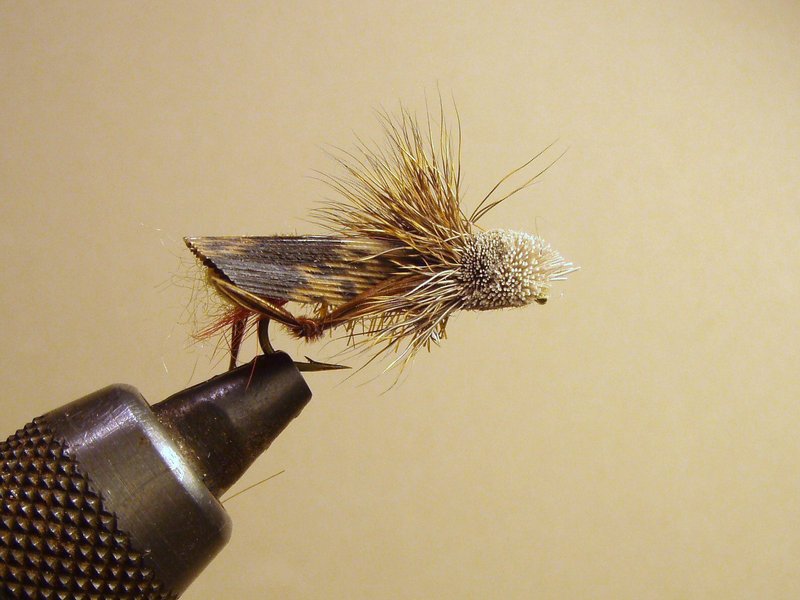
Dave's Hopper
Dave's Hopper stands as one of the most iconic and productive grasshopper imitations in fly fishing history. Created by Dave Whitlock in 1968, this pattern revolutionized terrestrial fly fishing with its realistic profile, high visibility, and exceptional floatability. The fly combines deer hair, turkey quill, and rubber legs to create a lifelike grasshopper silhouette that sits perfectly in the surface film. The pattern's effectiveness stems from its multi-dimensional appeal to trout. The deer hair head and collar provide excellent flotation while creating a realistic body shape. The turkey quill wing segments mimic the mottled appearance of a grasshopper's wings, and the rubber legs add crucial movement and lifelike action in the water. The yellow or tan body options allow anglers to match different grasshopper species found along trout streams. Dave's Hopper excels in late summer and early fall when grasshoppers are most abundant along stream banks. Trout become conditioned to feeding on these protein-rich terrestrials, often cruising near banks waiting for the next unfortunate hopper to fall into the water. The fly works best when cast tight to grassy banks, undercut areas, and overhanging vegetation where grasshoppers naturally live. This pattern has proven effective across all major trout waters in the United States, from Montana's spring creeks to Colorado's freestone rivers, Wyoming's mountain streams, and California's Sierra Nevada waters. Its versatility extends to both small streams where a size 12 works perfectly, and larger rivers where a size 6 or 8 creates an irresistible meal for trophy trout. The fly's high visibility also makes it an excellent choice for use as a dry fly indicator in hopper-dropper rigs, allowing anglers to fish a nymph below while still presenting an effective surface pattern.
Pattern Details
- Type
- Terrestrial
- Seasons
- summer, fall
- Hook Sizes
- #6-12
- Hook Type
- 2X-3X long dry fly hook
- Tying Difficulty
- Intermediate
- Imitates
- Grasshopper
Recipe & Materials
- Hook
- TMC 5212 or similar 2X-3X long, sizes 6-12
- Thread
- 6/0 yellow or tan
- Tail
- Red deer hair and turkey quill
- Body
- Yellow or tan dubbing
- Rib
- Brown hackle, palmered
- Wing
- Turkey quill sections
- Collar
- Natural deer hair, spun and clipped
- Legs
- Yellow or tan rubber legs
- Head
- Spun and clipped deer hair
Technique & Presentation
Begin by tying in the tail components at the hook bend, using a small bunch of red deer hair topped with a turkey quill segment. Secure the hackle by the tip at the bend for later palmering. Create a dubbed body from the bend to about two-thirds up the shank, then palmer the hackle forward over the body and tie off.
The wings require careful preparation. Select matching turkey quill sections from left and right feathers, ensuring they're symmetrical. Tie them in tent-style over the body, angling slightly back. The wing length should extend just past the hook bend. Position rubber legs on each side of the body before proceeding to the collar.
The deer hair work separates this pattern from simpler hoppers. Spin a collar of natural deer hair around the hook shank, pack it tightly, then spin another clump for the head. Use a hair packer to compress the deer hair firmly. Trim the head to a rounded, bullet-shaped profile, leaving some fibers extending back over the wing to represent the hopper's thorax. The bottom should be trimmed flat so the fly sits properly in the surface film. Coat the underside of the body with floatant before fishing.
History & Origin
Dave Whitlock developed Dave's Hopper in 1968 while fishing Oklahoma's trout waters, though its fame grew through his guiding work in Montana and Arkansas. Whitlock sought to create a grasshopper pattern that combined realism with durability and floatability, three qualities rarely achieved together in terrestrial patterns of that era. His design drew inspiration from earlier hopper patterns like Joe's Hopper but incorporated innovative use of materials.
The pattern gained widespread recognition through Whitlock's influential articles in fly fishing magazines during the 1970s and his appearances in fly fishing films. His detailed tying instructions and willingness to share the pattern helped it spread across the country. By the 1980s, Dave's Hopper had become a staple in fly shops from coast to coast.
Whitlock's pattern has spawned countless variations, but the original formula remains the most popular. Its success influenced an entire generation of terrestrial patterns, demonstrating that realistic impressionism could be more effective than exact imitation. Today, Dave's Hopper appears in nearly every comprehensive fly box and continues to fool selective trout more than fifty years after its creation.
Where to Fish This Fly
East Fork Black River
Eastern Arizona / White Mountains
Oak Creek
Central Arizona / Oak Creek Canyon
South Fork Snake River
Eastern Idaho
Missouri River
Central Montana
Tuckasegee River
Western North Carolina / Jackson County
Linville River
Western North Carolina / Avery County
Pecos River
North-Central New Mexico / San Miguel & Santa Fe Counties
Rio Chama
North-Central New Mexico / Rio Arriba County
Yakima River
Central Washington
Bighorn River (Wyoming)
North Central Wyoming
Related Terrestrial Patterns
Fat Albert
The Fat Albert is a burly, high-floating terrestrial pattern designed to imitate large grasshoppers and other substantial land-based insects. Created by fly fishing innovator Jack Dennis, this fly features a foam body that provides exceptional flotation, making it ideal for both direct presentation and as an indicator in hopper-dropper rigs. The Fat Albert's chunky profile and highly visible design make it a favorite during the late summer terrestrial season when trout actively feed on hoppers along stream banks. This pattern excels at imitating the larger grasshopper species that thrive in Western ranch country and meadow streams. When grasshoppers are abundant in late July through September, trout station themselves near grassy banks waiting for these meaty morsels to tumble into the water. The Fat Albert's substantial profile triggers aggressive strikes from trout that have become conditioned to feeding on hoppers, often producing explosive surface takes that make terrestrial fishing so exciting. The fly's foam construction offers several advantages beyond flotation. The closed-cell foam is virtually unsinkable, allowing anglers to fish the pattern through choppy riffles and turbulent pocket water where natural hoppers often land. The foam body also provides an excellent platform for rubber legs that create enticing movement even when the fly sits motionless. High-visibility colors like chartreuse or hot orange make the fly easy to track in broken water or low light conditions. Fat Albert works exceptionally well throughout the Rocky Mountain West, including Montana, Wyoming, Colorado, Idaho, and New Mexico waters where grasshoppers are abundant. It's equally effective in California's Sierra Nevada streams, Oregon's high desert rivers, and Washington's eastern slope waters. The pattern performs best when cast tight to grassy banks, under overhanging vegetation, and near cut banks where hoppers naturally fall. Many anglers use Fat Albert in sizes 8-10 as an indicator for nymph droppers, creating a deadly hopper-dropper combination that covers both surface and subsurface feeding zones.
Spruce Moth
The Spruce Moth is a distinctive terrestrial pattern designed to imitate the various moth species that populate forested areas surrounding trout streams. These soft-bodied insects become important trout food during summer and fall when moths emerge from forests and are blown or fall onto the water's surface. The pattern's unique construction, featuring peacock herl, badger hackle, and deer hair wings, creates a bushy, high-floating fly that suggests the fuzzy body and fluttering wings of natural moths. Moths are often overlooked as trout food compared to more famous terrestrials like grasshoppers and beetles, but they represent significant feeding opportunities, particularly on wilderness streams and in mountainous regions with extensive conifer forests. The spruce moth and similar species are most active during evening hours and on cloudy days, when they fly near water or rest on streamside vegetation. Wind, rain, or simple clumsiness causes them to land on the water, where they create disturbances that attract cruising trout. The Spruce Moth pattern excels in pocket water, along undercut banks, and beneath overhanging vegetation where terrestrials are most likely to fall. Its buoyant construction keeps it riding high even in turbulent water, and the deer hair wings provide excellent visibility for anglers tracking the fly through complex currents. The pattern works particularly well in the late afternoon and evening when natural moths are most active, though it can produce throughout the day during peak terrestrial season. This fly shines on forested mountain streams where spruce, pine, and fir forests border the water. Rivers flowing through Montana, Idaho, Wyoming, and Colorado wilderness areas see heavy moth activity, making the Spruce Moth an essential pattern for backcountry anglers. The pattern also works on larger rivers with wooded corridors, particularly during overcast conditions or after storms when wind blows terrestrials onto the water. Its effectiveness extends beyond strict moth imitation—the fly suggests various large, fuzzy terrestrials and can trigger opportunistic strikes from trout looking for substantial meals.