Browns Lake
Browns Lake is a 549-acre trophy rainbow stillwater in the Blackfoot Valley near Ovando, shallow enough that its fish are almost always within reach of a floating line. Dense chironomid emergences, Callibaetis, and June damselfly migrations over broad weed flats make it one of western Montana's favorite fly-only-minded lakes.
Overview
Browns Lake lies in the open, wind-scoured country of the Blackfoot Valley a few miles from Ovando, 549 acres of shallow, fertile water at 4,294 feet. Nothing about it looks like the postcard Montana of canyon rivers and pine-dark banks. It is a broad, weedy, prairie-edged basin surrounded by grass and sage with the Swan and Garnet ranges standing back at the horizon, and it fishes almost nothing like the freestone rivers that made this valley famous. Fly anglers who make the drive out from Missoula do it for one reason: the rainbows here grow thick and long, and they spend much of the season cruising water shallow enough to see them.
Montana Fish, Wildlife & Parks manages Browns as a stocked trophy rainbow fishery, and the hatchery record backs that up. Recent plants include roughly 9,675 Arlee-strain rainbows at 4.3 inches and 15,000 Eagle Lake rainbows at 3.6 inches in 2026, with larger 6- to 7-inch Arlee fish going in during the fall of 2025. Those fish drop into a shallow, weed-rich basin that produces scuds, chironomids, damselflies, and mayflies in enormous numbers, and they put on weight fast. Rainbow trout are the entire show at Browns; there is no bycatch to speak of, and everything you hook has been eating well.
What makes the lake special for a fly rod is its geometry. Maximum depth is only 27 feet and the average is around 10, which means there is no deep sanctuary where trout become a downrigger's problem in midsummer. Fish stay in the top layer all season and are always reachable with a floating or intermediate line. The shallow shelves and weedbeds that ring the lake are cruising lanes, and on calm mornings you can watch fish work a beat, intercept them, and get an honest look at the eat. That combination of visible fish and reachable water is rare in Montana stillwaters.
The calendar runs from ice-out into early summer at its best. Chironomids come off in staggering numbers as soon as the ice releases, and fish that spent winter under a lid feed hard along the first warming shelves. Callibaetis follow, giving the lake its gulper hours on flat mornings, and by June the damselfly migration pushes thousands of olive nymphs toward the weed edges and shoreline rocks with trout shouldering into the middle of it. Late summer heat can slow a lake this shallow, but autumn cooling brings the fish back on the feed for a strong fall streamer and leech window.
Browns Lake is not big water, but it fishes big. A float tube or a small boat opens the whole basin, and long stretches of the weedy margin are wadeable for anglers who would rather stand and hunt. It is the sort of place a serious stillwater angler returns to year after year, learning which flats warm first, where the damsels stage, and which windward shoreline stacks food on a rough afternoon.
Depth & Character
- Surface Area
- 549acres
- Max Depth
- 27ft
- Mean Depth
- 10ft
- Elevation
- 4,294ft
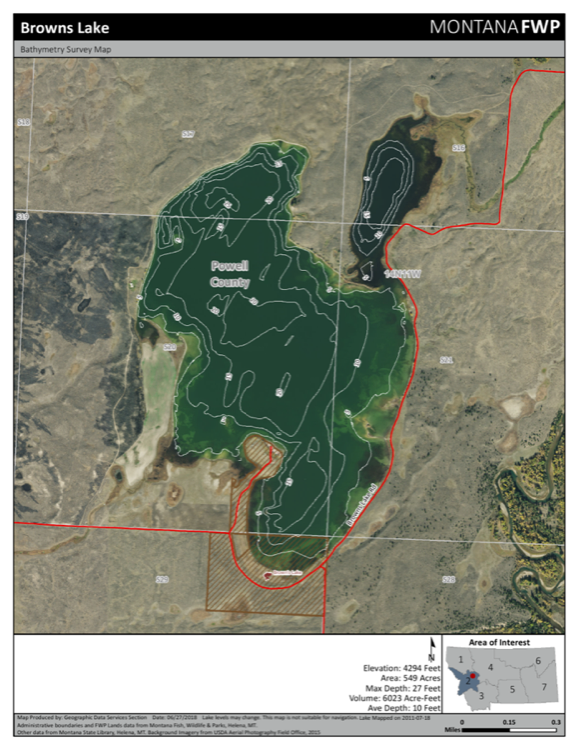
Bathymetric depth chart — click to open the full PDF. Source: Vermont DEC.
Source: Vermont DEC
Water Characteristics
Browns is a shallow, fertile, wind-exposed natural lake with a maximum depth of 27 feet and a mean depth near 10. There is no meaningful deepwater refuge and no strong summer thermocline the way there is on Montana's big reservoirs, so the trout population lives, feeds, and holds inside the range of a floating or intermediate line all season. The depth chart shows a broad, gently contoured basin: most of the lake sits in single-digit to mid-teen depths, with the deeper hole confined to a limited central area and the contours widening out toward large shallow shelves along the margins.
Those shelves are the fishery. Extensive weed growth carpets the shallows, producing the scuds, chironomid larvae, damselfly nymphs, and dragonfly nymphs that build heavy rainbows in a short growing season. Water clarity varies with wind and algal productivity: early season the lake is often clear enough for genuine sight fishing over the flats, while midsummer productivity and afternoon chop can green it up considerably.
Wind is a permanent feature of the Blackfoot Valley and a constant factor here. Open country gives a breeze long fetch across the basin, and a mirror-calm dawn frequently becomes a whitecapped afternoon. Rather than fighting it, most anglers use it, working the windward weed edges where food gets pushed and concentrated.
Stocking
| Species | Size | Number | Program |
|---|---|---|---|
| Rainbow Trout (Arlee strain) | 4.3 in | 9,675 | Montana FWP 2026 plant |
| Rainbow Trout (Eagle Lake strain) | 3.6 in | 15,000 | Montana FWP 2026 plant |
| Rainbow Trout (Arlee strain) | 6-7 in | Count not published | Montana FWP fall 2025 plant of larger fish |
Seasonal Fishing Guide
Spring
The prime window. Chironomids emerge densely from ice-out, and rainbows feed hard along the first shelves to warm. Anchor over 6-15 feet near weed edges and suspend a Chironomid Bomber or Zebra Midge a foot off bottom under an indicator. As May progresses, Callibaetis nymphs and early damsels enter the mix and sight-fishing to cruisers over the flats becomes realistic on calm mornings.
Summer
June is the damselfly month: fish olive damsel nymphs along weed edges and shoreline structure through the migration. Callibaetis gulper fishing peaks on flat mornings, with a Parachute Adams or Callibaetis Sparkle Dun cast ahead of a working fish. As July heat builds on this shallow lake, shift to first light and last light, and work dragonfly nymphs and leeches deeper along the weed drop-offs.
Fall
Cooling water pulls fish back into the shallows on the feed. Strip Woolly Buggers, leeches, and dragonfly nymphs on intermediate lines along the weedlines, and expect fewer anglers than in spring. Chironomid activity picks up again, and heavy, well-conditioned rainbows come to hand before ice-up.
Winter
The lake freezes and the fly season closes out. Confirm current winter season dates and any special regulations for Browns Lake with Montana FWP, and check ice conditions locally, before planning a cold-weather trip.
Access & Boats
The Montana FWP fishing access site near Ovando provides the main entry, with a boat ramp and shoreline access to the lake. Because the lake averages only about 10 feet deep, it is ideal float tube and small boat water; a pram, pontoon, or kayak covers the basin easily and lets you anchor over specific weed edges. Shoreline anglers do well too, as the weedy margins are extensively wadeable and hold cruising fish through the early season. Getting there means gravel and county roads off Highway 200 in the Ovando area, so allow travel time and check conditions in shoulder seasons.
Ice Fishing
Winter is not part of the fly angler's calendar at Browns Lake; the fly seasons run from ice-out through fall, and shallow lakes like this ice over solidly. If you plan a winter trip, confirm the current standing-water season dates, any winter-specific restrictions, and safe ice conditions locally before going, since regulations on trophy-managed waters can differ from Montana's general rules.
Fishing Pressure & Local Tips
Browns has a strong reputation among western Montana fly anglers and sees steady traffic on prime spring weekends, particularly in the weeks after ice-out when word gets out that the chironomids are going. Pressure is nonetheless manageable: the lake is a genuine destination rather than a roadside stop, and weekdays through May and June often see only a handful of tubes on the water. Late summer is the quietest stretch, and the fall window goes largely unfished compared to the spring rush.
Local Knowledge
Fish the shallow end of your instincts. On most Montana stillwaters the reflex is to look for depth; at Browns the fish are usually shallower than you think, working 4 to 12 feet over weed tops. Anchor or hover just off a weed edge, hang chironomid pupae a foot or two off the bottom under an indicator, and resist moving. The most common mistake here is covering water instead of letting a good lie produce.
Learn the damsel migration. Through June, olive damselfly nymphs swim toward the weed edges, shoreline rocks, and any emergent structure, and rainbows follow them into inches of water. A slim damsel nymph on a long leader retrieved with short, steady strips parallel to a weedline is the single best presentation on the lake during that window. Cast ahead of a cruising fish rather than at it, and keep the fly moving through the eat.
Use the wind rather than hiding from it. When the chop builds, the windward shoreline collects drifting food and warms slightly, and a Woolly Bugger or leech stripped along that edge on an intermediate line takes fish that will not touch a dry. Save the flat calm mornings for Callibaetis gulpers and the choppy afternoons for streamers, and you will have a productive day in almost any weather.
Species Present
Food Sources & Hatches
| Insect | Suggested Fly | Jan | Feb | Mar | Apr | May | Jun | Jul | Aug | Sep | Oct | Nov | Dec |
|---|---|---|---|---|---|---|---|---|---|---|---|---|---|
Chironomids (Midges) Morning through midday, with a second push in the evening | Chironomid (Bomber) | ||||||||||||
Chironomid Pupae (small, deep presentation) All day | Zebra Midge | ||||||||||||
Callibaetis Late morning on calm days; spinners in the evening | Parachute Adams | ||||||||||||
Damselflies Mid-morning through afternoon | Damselfly Nymph | ||||||||||||
Dragonfly Nymphs All day, best in low light | Dragonfly Nymph | ||||||||||||
Scuds All day | Ray Charles | ||||||||||||
Leeches Early morning, evening, and any time the wind is up | Woolly Bugger |
Chironomids (Midges): The backbone of the Browns Lake food chain. Emergences begin immediately at ice-out and continue all season. Fish pupae suspended a foot or two off bottom over the 6-15 foot weed edges; black, red, and olive bodies with a silver rib cover most days.
Chironomid Pupae (small, deep presentation): When fish refuse a larger bomber, drop to a size 16-18 Zebra Midge on 5X fluorocarbon. In clear early-season water the smaller, sparser profile is often the difference between watchers and takers.
Callibaetis: The classic Montana stillwater mayfly, and the source of the lake's gulper hours. Cast ahead of a cruising fish's line of travel rather than at the last rise ring. Nymphs fished with a slow hand-twist retrieve produce well before the duns appear.
Damselflies: The June damsel migration is a signature event here, with olive nymphs swimming toward weed edges and shoreline structure in huge numbers. Retrieve a slim olive nymph in short, steady strips parallel to the weedline; takes are often violent.
Dragonfly Nymphs: Big, protein-rich, and available all season in the weedbeds. A large olive or brown dragon nymph crawled and paused along a weed drop-off is a reliable way to pull a heavy fish when nothing is showing on top.
Scuds: The fertile weedbeds hold scuds year-round, and they are a major reason Browns rainbows put on so much weight. Fish a small tan, olive, or gray scud pattern slowly over and through the weed tops, especially in spring before the insect hatches peak.
Leeches: A constant forage item and the all-conditions searching fly. Strip black, olive, or maroon leeches and Woolly Buggers on an intermediate line along the windward weed edges when the chop is on.
Recommended Flies
Chironomid (Bomber)
Top PickThe essential Browns Lake fly. Fish chironomid pupae under an indicator, hung a foot or two off bottom over 6-15 feet along the weed edges, from ice-out onward. Carry black, red, and olive in sizes 12-16.
Best in Spring through fall
Damselfly Nymph
Top PickIndispensable during the damselfly migration. A slim olive nymph stripped in short, steady pulls parallel to the weedline draws the season's most aggressive eats.
Best in June through July
Parachute Adams
Top PickThe go-to dry when Callibaetis gulpers work the flats on flat calm mornings. Sizes 14-16; lead the fish rather than casting to the rise.
Best in Summer
Woolly Bugger
Top PickThe all-purpose searching pattern on an intermediate line. Black and olive in sizes 6-10 cover leeches and general forage; the best choice when wind puts a chop on the water.
Best in Spring through fall
Also Effective
Access Points & Boat Launches
Browns Lake Fishing Access Site (Boat Ramp)
Boat LaunchEasyThe Montana FWP fishing access site near Ovando is the primary entry to the lake, with a boat ramp serving the shallow basin. Launch here for small boats, prams, pontoons, and kayaks; the whole lake is within easy reach given its modest size and uniform depth. Reached by gravel and county roads off Highway 200 in the Ovando area.
Weedy Shoreline Margins (Wade and Float Tube)
Wade AccessEasyExtensive shallow, weedy margins ring the lake and are wadeable for anglers who prefer to hunt cruising fish on foot. These same shelves are the natural launch zone for float tubes and pontoons, which are arguably the ideal craft here given an average depth of about 10 feet. Best in spring and early summer when rainbows patrol the flats within casting range of shore.
Regulations
Regulations
Browns Lake has historically been managed with restrictive, artificial-lure-oriented regulations aimed at producing trophy rainbows, so it does not necessarily follow Montana's standard Western District rules. Bag limits, tackle restrictions, and season dates on trophy-managed waters change, and this is a lake where the specifics matter. A Montana fishing license is required. Verify the current special regulations and limits for Browns Lake at myfwp.mt.gov before you fish or keep anything.
Always verify current regulations with Montana Fish, Wildlife & Parks before fishing.
Quick Facts
- Surface Area
- 549 acres
- Max Depth
- 27 ft
- Elevation
- 4,294 ft
- Lake Type
- Natural Lake
- Region
- Western Montana / Blackfoot Valley; Powell County
- Best Seasons
- spring, summer, fall
- Species
- Rainbow Trout
- Difficulty
- Beginner-Intermediate
- Record Fish
- Browns is known regionally for producing heavy, deep-bodied rainbows out of proportion to its size, a product of a shallow, food-rich basin and a stocking program managed for trophy fish rather than numbers.
- Depth Chart
- Download PDF
Nearby Lakes & Ponds
Georgetown Lake
Southwest Montana / Anaconda-Pintler; Deer Lodge and Granite Counties
Hebgen Lake
Southwest Montana / Madison Valley; Gallatin County
Clark Canyon Reservoir
Southwest Montana / Beaverhead Valley; Beaverhead County
Dailey Lake
South-central Montana / Paradise Valley; Park County
Canyon Ferry Lake
West-central Montana / Missouri River; Broadwater and Lewis and Clark counties
Placid Lake
Western Montana / Clearwater Valley; Missoula County