Placid Lake
Placid Lake is a deep, clear 1,211-acre stillwater in the Clearwater chain of the Seeley-Swan valley, holding westslope cutthroat, rainbow trout, and kokanee. A state park boat ramp, weedy shallow shelves, and far less traffic than neighboring Seeley Lake make it a quiet fly-rod alternative in western Montana.
Overview
Placid Lake sits at 4,149 feet in the Clearwater Valley, one link in the chain of lakes strung along the Seeley-Swan corridor west of the Mission and Swan ranges. At 1,211 acres it is a substantial piece of water — larger than nearby Salmon Lake and considerably deeper, with a maximum depth of 90 feet and a mean depth of 45 feet. Where many of the valley's lakes are shallow and weed-choked from end to end, Placid combines fertile, fishable shallows with a genuinely deep central basin, and that combination is what gives the lake its mix of surface-oriented trout and deep-holding kokanee.
The fishery is built on three species. Westslope cutthroat trout are the headline fish and the one a fly angler is most likely to catch: Montana Fish, Wildlife & Parks has kept up a regular fall stocking program, planting on the order of 12,000 fingerling-to-yearling cutthroat each autumn in recent years. Rainbow trout share the shallows and the drop-off edges. Kokanee — planted in far larger numbers, roughly 40,000 fry in a recent year — occupy the deep water for most of the season and are primarily a gear angler's quarry, though they matter to the fly angler as forage and as a reason the lake supports well-conditioned trout. Arctic grayling and coho salmon appear in the lake's historical stocking record, a reminder that Montana's Clearwater lakes have been managed and re-managed for a century, but neither is part of the current fishery.
What makes Placid work with a fly rod is its shelf structure. The shallow, weedy margins produce the insect life — chironomids from ice-out, Callibaetis mayflies through the warm months, damselflies migrating shoreward in early summer — and cutthroat and rainbows cruise those shelves in the low-light hours to feed. Push out a cast or two and the bottom falls away; the drop-off edge where weed meets deep water is the single most productive line on the lake, and it fishes well to a leech or Woolly Bugger on an intermediate line at almost any time of year.
Placid Lake State Park anchors access, with a boat ramp and a campground that make this an easy lake to fish for a weekend rather than an afternoon. It is float-tube and small-boat water first, though the weedy shorelines near the park and around the inlet are genuinely wadeable and give a bank angler a real shot. The lake is calmer and less developed than Seeley Lake a few miles up MT-83, and it carries markedly less recreational and angling pressure — reason enough for many western Montana anglers to turn off toward Placid instead.
The calendar here is a spring and fall calendar. Ice-out through early summer is the prime stretch, when trout hold shallow and the chironomid and damsel activity peaks, and September and October bring cruising cutthroat back onto the shelves as the water cools and the summer boat traffic disappears. Midsummer still fishes, but it fishes early and late, with midday best spent in the deeper water or off the lake entirely. For an angler working through the Clearwater chain, Placid pairs naturally with Salmon Lake to the south and makes an easy stillwater counterpoint to a week on western Montana's rivers.
Depth & Character
- Surface Area
- 1,211acres
- Max Depth
- 90ft
- Mean Depth
- 45ft
- Elevation
- 4,149ft
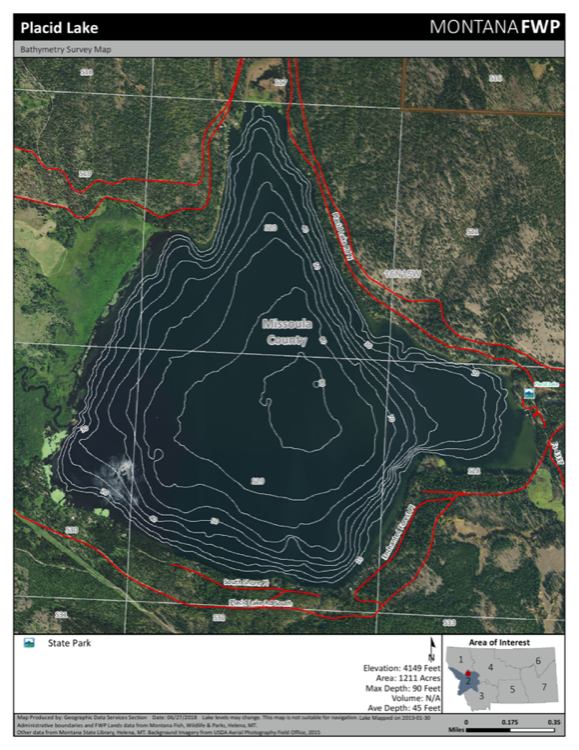
Bathymetric depth chart — click to open the full PDF. Source: Vermont DEC.
Source: Vermont DEC
Water Characteristics
Placid is a natural lake with a deep central basin — 90 feet at maximum, averaging 45 feet — ringed by shallower shelves that carry the lake's weed growth. The depth chart shows how quickly the contours tighten off the shoreline in places: broad shallow ground at the inlet and along protected margins, then a steepening slope into the main basin. That transition line is the structural feature to fish, and reading it off the bathymetry before launching is worth more than an hour of blind casting.
With 45 feet of mean depth, the lake stratifies through summer and holds a distinct thermocline. Kokanee and the larger trout follow cool, oxygenated water down as surface temperatures climb, which is why the shallow-water fishing collapses to dawn and dusk in July and August. Water clarity is good, typical of the deeper Clearwater-chain lakes, and clear water on a flat calm afternoon makes for spooky fish and long leaders.
The weedbeds are the food factory. Chironomids emerge from the soft bottom of the shallows from ice-out onward, Callibaetis mayflies hatch over the weed flats in the warm months, and damselfly nymphs make their shoreward migration in early summer. Dragonfly nymphs, scuds, and leeches live in the same water year-round and give a searching angler something to imitate on any day when nothing is emerging.
Stocking
| Species | Size | Number | Program |
|---|---|---|---|
| Westslope Cutthroat Trout | ~5.5 in | 12,000 | Montana FWP annual fall plant (2024-2025) |
| Kokanee Salmon | ~2.5 in | 40,000 | Montana FWP kokanee plant (2024) |
Seasonal Fishing Guide
Spring
Ice-out through early June is the best window of the year. Cutthroat and rainbows hold on the shallow shelves in cold water, and chironomid emergences start almost immediately after the ice leaves. Anchor or hover over 8 to 20 feet along the weed edge and fish chironomid pupae under an indicator, or cover water with a leech or Woolly Bugger on an intermediate line. Overcast, breezy days beat bluebird calm on this clear lake.
Summer
The lake stratifies and the shallow fishing compresses into the first and last hours of light. Damselfly nymphs migrating toward shore in June and early July are the best opportunity of the season for a shallow-water eat — fish an unweighted damsel nymph with slow, twitching strips just over the weed tops. Callibaetis duns bring cruising fish up over the flats on calm mornings; a Parachute Adams or Callibaetis sparkle dun fished to a visible riser is the game. Midday, drop a dragonfly nymph or bugger along the drop-off.
Fall
September and October are the second prime season. Cooling water pulls cutthroat and rainbows back onto the shelves for longer stretches of the day, the campground empties, and the lake goes quiet. Strip leeches and Woolly Buggers along the weed edges and off points, and expect the most aggressive streamer eats of the year. Late-season midge activity on calm evenings can still bring fish to the surface.
Winter
The lake freezes and the fishery shifts to ice anglers targeting trout and kokanee. There is no practical fly fishing. Check Montana FWP for current winter season rules and get local information on ice conditions before going out.
Access & Boats
Placid Lake State Park, reached by county road off MT-83 in the Clearwater Valley, provides the main public access with a boat ramp and campground. The ramp handles trailered boats easily and is equally convenient for launching a canoe, kayak, or pram, and the campground makes multi-day trips practical. Float tubes and small craft are the ideal tools here — they let an angler park on the weed edge and work the drop-off line without spooking cruising fish.
Shore anglers are not shut out. The weedy shorelines near the park and the shallow water around the inlet are wadeable, and cutthroat push into that water in the early morning and evening. A bank angler with a floating line and a damsel or chironomid pattern can have a productive session without ever getting in a boat, though the full shoreline and the best drop-off structure open up only from the water.
Ice Fishing
Placid sits at 4,149 feet in western Montana and locks up in winter like the rest of the Clearwater chain, and winter anglers on these lakes generally target trout and kokanee through the ice. It is not a fly-rod season, and this guide's tactics assume open water. Ice conditions in the Seeley-Swan vary a great deal year to year, so check local reports for ice thickness and confirm current winter season rules with Montana FWP before heading out.
Fishing Pressure & Local Tips
Light to moderate, and light by the standards of western Montana. Seeley Lake, a few miles north on MT-83, absorbs most of the valley's recreational and angling traffic, and Placid functions as the quieter alternative — a lake where a weekday morning in May or October often means having the shelves to yourself. Summer brings campground and recreational boat use centered on the state park, which is another argument for fishing the first and last hours of daylight. Kokanee draw a dedicated gear-angling following, but fly-specific pressure on the shallow shelves is minimal.
Local Knowledge
Fish the weed edge, not the open water. The single most reliable pattern on Placid is to position a float tube or small boat just outside the weedline and cast either direction — a leech or Woolly Bugger on an intermediate line worked back along the drop-off edge covers cruising cutthroat and rainbows, and it produces from ice-out through October.
Go early and stay late. Cutthroat move onto the shallow shelves in low light and drop back as the sun climbs, and that rhythm holds all season but becomes absolute once the lake stratifies in July. A dawn session over the weed flats with a chironomid pupa under an indicator, followed by a midday break and an evening Callibaetis window, is a far better plan than grinding through the afternoon.
Watch for cruising fish before you cast. On flat calm mornings the shallows are clear enough to see a cutthroat working a lane, and a fly placed ahead of a moving fish beats a fly retrieved through empty water. When wind puts a chop on the surface, that same visibility disappears — but so does the fish's caution, and it becomes the right time to strip a bugger with confidence. If the shallows go quiet mid-season, do not chase the kokanee down into the basin with a fly rod; move to the inlet area or fish deeper along the drop-off instead.
Species Present
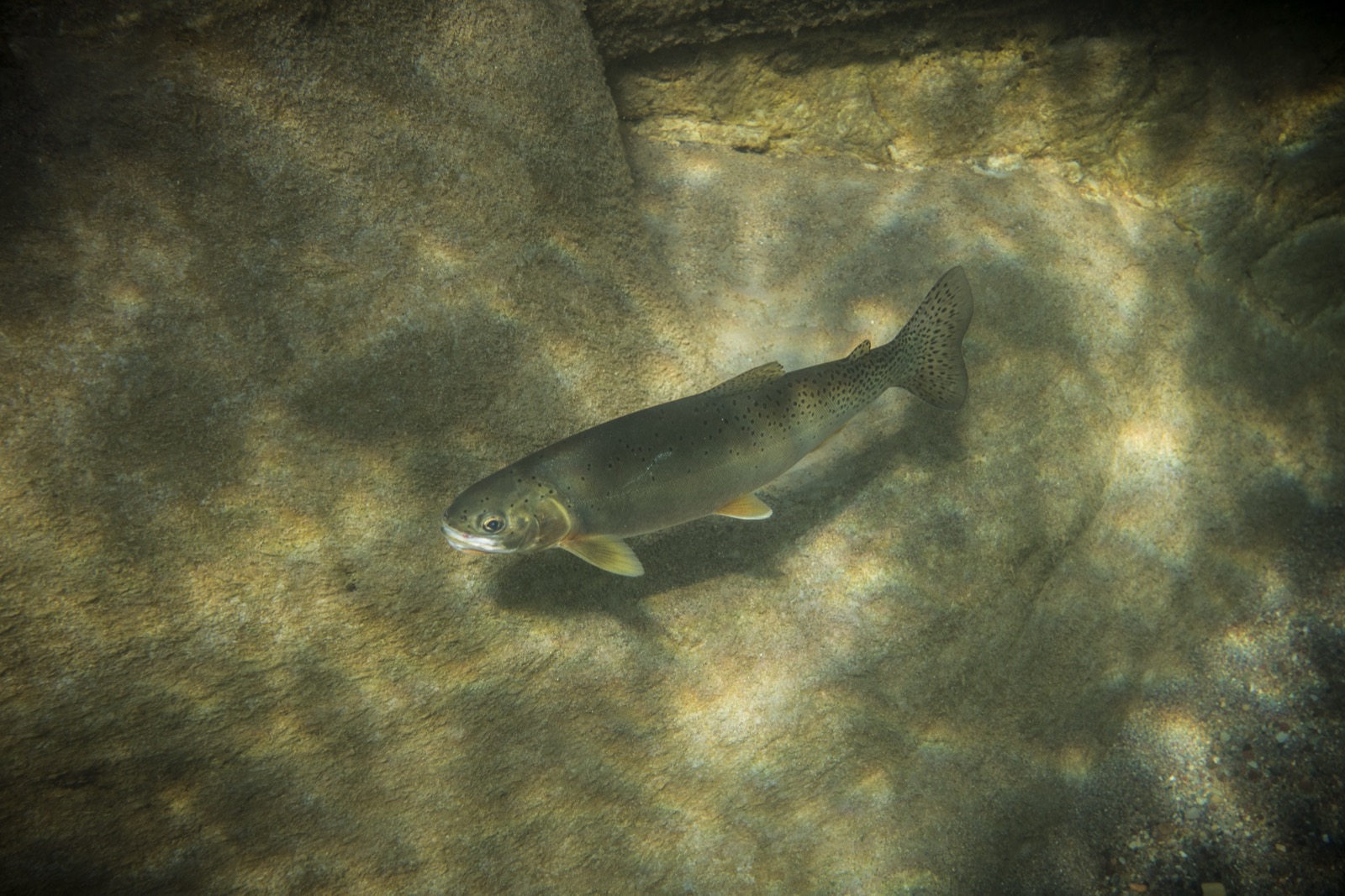
Westslope Cutthroat Trout
The westslope cutthroat trout is the most widely distributed native trout subspecies in the northern Rocky Mountains and holds the distinction of being Montana's official state fish. This interior subspecies of cutthroat trout evolved in the upper Columbia and Missouri River drainages west of the Continental Divide, inhabiting the cold, pristine mountain streams and alpine lakes of Idaho, western Montana, and pockets of eastern Washington and Oregon. Smaller and more delicately built than their Yellowstone cutthroat cousins, westslope cutthroats are a jewel of the backcountry, their buttery gold flanks peppered with fine black spots and accented by the hallmark crimson slashes beneath the jaw that define all cutthroat trout. Westslope cutthroats are the quintessential dry-fly trout of the northern Rockies. Found in headwater streams, cascading mountain creeks, and glacially carved alpine lakes from the Bitterroot Range to the Bob Marshall Wilderness, they inhabit some of the most breathtaking landscapes in the American West. On waters like the upper Blackfoot River, Rock Creek, the South Fork Flathead, and the St. Joe River in Idaho, westslope cutthroats rise eagerly to well-presented dry flies, often in settings so remote and wild that the fishing feels almost primeval. Their willingness to eat on the surface, combined with the spectacular scenery of their home waters, makes targeting westslope cutthroats one of the most rewarding experiences in western fly fishing. Despite their cultural and ecological importance, westslope cutthroat trout occupy only a fraction of their historic range. Hybridization with non-native rainbow trout and competition from introduced brook trout have eliminated genetically pure populations from many drainages. Today, the purest remaining westslope cutthroat populations persist in isolated headwater streams above natural or man-made barriers that prevent upstream migration of non-native species. Conservation efforts across Idaho, Montana, and Washington focus on protecting these stronghold populations, removing non-native competitors, and restoring connectivity where genetically pure fish still exist. Anglers who target westslope cutthroats become some of their strongest advocates, understanding firsthand the fragile beauty of the ecosystems these fish depend upon.
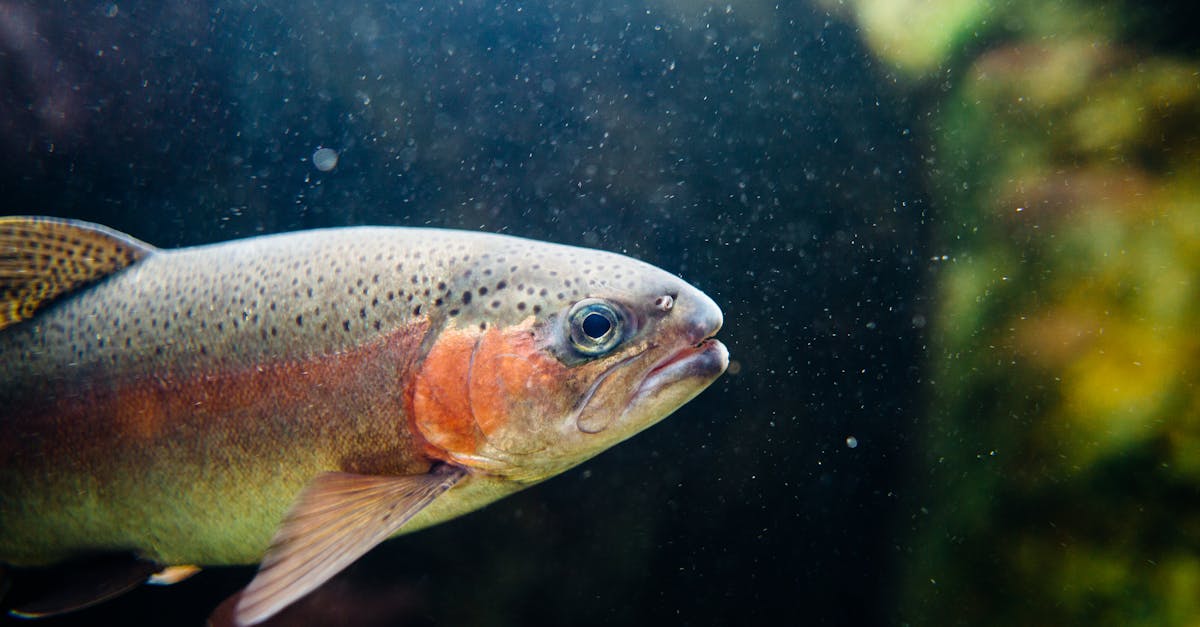
Rainbow Trout
The rainbow trout is Montana's most widespread and popular gamefish, celebrated for its explosive surface strikes, aerial acrobatics, and willingness to take a well-presented dry fly. Native to Pacific Coast drainages from Alaska to Mexico, rainbows were first introduced to Montana's waters in the late 1800s and have since established thriving populations in nearly every major river system in the state. On legendary waters like the Madison, Missouri, and Bighorn, wild rainbow trout grow fat on prolific insect hatches and provide some of the finest dry-fly fishing in North America. Rainbow trout in Montana display remarkable variation depending on their home water. Fish in nutrient-rich tailwaters like the Missouri River below Holter Dam can exceed 20 inches with regularity, their deep bodies and broad tails reflecting the abundant food supply. Freestone river rainbows, such as those in the upper Madison and Gallatin, tend to be leaner and more athletic, shaped by faster currents and colder water temperatures. In many Montana rivers, rainbows spawn in the spring from March through June, and anglers should be mindful of spawning redds during this period to protect future generations of fish. Rainbows are arguably the most versatile trout species for fly anglers. They respond well to dry flies during hatches, aggressively chase streamers, and feed heavily on nymphs subsurface throughout the year. Their fighting ability is legendary: a hooked rainbow will often launch itself completely out of the water multiple times during a battle. Montana's catch-and-release regulations on many blue-ribbon streams have produced exceptional rainbow trout fisheries with high densities of large, healthy fish that continue to draw anglers from around the world.
Kokanee Salmon
The kokanee salmon is the landlocked, freshwater-resident form of the sockeye salmon (Oncorhynchus nerka), a fish that completes its entire life cycle in lakes and their tributaries without ever migrating to the sea. Where sockeye salmon spend their adult lives in the Pacific Ocean before returning to spawn, kokanee remain permanently in freshwater, using large, cold, nutrient-rich lakes as their marine substitute. Though they are the same species, kokanee mature at a much smaller size than sea-run sockeye, typically maturing at 10 to 16 inches, and they have become one of the most important coldwater gamefish and forage species across the reservoirs and lakes of the western United States. Kokanee are prized both as a sport fish and as a table fish, with rich, orange-red flesh comparable to their ocean-going sockeye relatives. They travel in large, roving schools that suspend in the cold open water of lakes, feeding on plankton, and this schooling behavior makes them a favorite target of trollers who can locate a school and take fish after fish. In Montana, kokanee support popular fisheries in Georgetown Lake, the Rocky Mountain Front reservoirs, and historically in the Missouri River reservoirs such as Hauser Lake, where the state record fish was taken. The dramatic spawning runs, when the lake turns red with maturing fish, are a signature autumn spectacle in the northern Rockies. Kokanee also play a crucial ecological role as the primary forage for trophy trout in many western lakes. Large lake trout, bull trout, brown trout, and rainbow trout grow to enormous sizes in lakes where kokanee are abundant, and fisheries managers carefully balance kokanee populations against predator demand. This dual role, as both a beloved sport fish in their own right and the foundation of trophy trout fisheries, makes the kokanee one of the most managed and monitored fish in the West. For the fly angler, kokanee present a unique challenge, since their plankton-feeding habits make them far less inclined to chase a fly than most salmonids.
Food Sources & Hatches
| Insect | Suggested Fly | Jan | Feb | Mar | Apr | May | Jun | Jul | Aug | Sep | Oct | Nov | Dec |
|---|---|---|---|---|---|---|---|---|---|---|---|---|---|
Chironomids (midges) Early morning and evening; all day in cool weather | Chironomid (Bomber) | ||||||||||||
Chironomid pupa (small, deep presentation) Dawn and dusk | Zebra Midge | ||||||||||||
Callibaetis mayfly Mid-morning through early afternoon on calm days | Parachute Adams | ||||||||||||
Damselfly nymph migration Mid-morning through afternoon | Damselfly Nymph | ||||||||||||
Dragonfly nymph All day | Dragonfly Nymph | ||||||||||||
Leeches and scuds All day; best early and late | Woolly Bugger | ||||||||||||
Midge clusters on flat water Calm evenings and first light | Griffith's Gnat |
Chironomids (midges): The foundation food source on Placid, emerging from the soft bottom of the shallow shelves from ice-out onward. Fish pupae under an indicator over 8 to 20 feet along the weed edge, hung a foot off the bottom.
Chironomid pupa (small, deep presentation): A small Zebra Midge covers the smaller chironomid sizes and works as the bottom fly on a two-fly indicator rig. Effective all season, and often the answer when a bomber-sized pupa is refused.
Callibaetis mayfly: Callibaetis hatch over the weed flats through the warm months and bring cutthroat and rainbows up to cruise and sip. Cast to visible risers rather than blind-fishing; a fly placed ahead of a moving fish is the whole technique.
Damselfly nymph migration: Early-summer damsel migration toward shore is the best shallow-water opportunity of the season. Fish an unweighted nymph with slow twitching strips just over the weed tops as nymphs swim shoreward.
Dragonfly nymph: Dragonfly nymphs live in the weedbeds year-round and make a reliable searching pattern when nothing is emerging. Crawl or strip along the drop-off edge on an intermediate line.
Leeches and scuds: Year-round forage in the weedy margins. A leech or Woolly Bugger retrieved along the weed edge on an intermediate line is the highest-percentage searching approach on the lake, spring through fall.
Midge clusters on flat water: Clustering adult midges on glassy water give a small-dry window when no mayflies are on. A Griffith's Gnat fished to sipping fish in the shallows converts a dead evening.
Recommended Flies
Woolly Bugger
Top PickThe go-to searching fly on Placid. Olive or black, fished along the weed-edge drop-off on an intermediate line with a slow strip-pause retrieve. Produces from ice-out through October and takes the largest cutthroat and rainbows in the lake.
Best in Spring through fall
Chironomid (Bomber)
Top PickChironomid pupa fished under an indicator over 8 to 20 feet along the shelves, suspended a foot off the bottom. The primary tactic from ice-out through June and the most consistent way to catch numbers of trout.
Best in Spring and early summer
Damselfly Nymph
Top PickTime this to the June and early-July damsel migration. Fish an unweighted nymph just over the weed tops with slow twitching strips as nymphs swim toward shore — the best shallow-water window of the summer.
Best in Early summer
Parachute Adams
Top PickCallibaetis dun imitation for cruising fish over the weed flats on calm mornings. Sizes 14-16. Cast ahead of a moving fish and let it sit; a dragged fly on this clear water ends the opportunity.
Best in Summer
Also Effective
Access Points & Boat Launches
Placid Lake State Park Boat Ramp
Boat LaunchEasyMain public access on the lake, reached by county road off MT-83 in the Clearwater Valley. Concrete ramp suitable for trailered boats and equally convenient for hand-launching canoes, kayaks, and float tubes. The adjacent state park campground makes this the natural base for a multi-day trip.
State Park Shoreline and Weed Flats
Wade AccessEasyWadeable weedy shoreline within walking distance of the state park, giving bank anglers access to the shallow shelves where cutthroat and rainbows cruise in low light. Best at dawn and dusk with a floating line and a damsel or chironomid pattern; firm footing gives way to soft bottom over the weedbeds.
Inlet Shallows
Wade AccessModerateShallow, weedy water at the inlet end of the lake, reachable by boat or float tube and wadeable where the bottom firms up. Inflowing water and the surrounding shallows concentrate insect life and hold cruising trout, particularly in spring and again once fall cooling starts. A productive first stop after launching.
Regulations
Regulations
Placid Lake falls under Montana's standard Western District regulations for trout and kokanee, covering season dates, daily limits, and any lake-specific provisions. Montana fishing licenses are required and are available through FWP. Regulations on Montana stillwaters change between seasons — confirm current season dates, limits, and any special provisions for Placid Lake at myfwp.mt.gov before you fish.
Always verify current regulations with Montana Fish, Wildlife & Parks before fishing.
Quick Facts
- Surface Area
- 1,211 acres
- Max Depth
- 90 ft
- Elevation
- 4,149 ft
- Lake Type
- Natural Lake
- Region
- Western Montana / Clearwater Valley; Missoula County
- Best Seasons
- spring, summer, fall
- Species
- Westslope Cutthroat Trout, Rainbow Trout, Kokanee Salmon
- Difficulty
- Beginner-Intermediate
- Depth Chart
- Download PDF
Nearby Lakes & Ponds
Georgetown Lake
Southwest Montana / Anaconda-Pintler; Deer Lodge and Granite Counties
Hebgen Lake
Southwest Montana / Madison Valley; Gallatin County
Clark Canyon Reservoir
Southwest Montana / Beaverhead Valley; Beaverhead County
Browns Lake
Western Montana / Blackfoot Valley; Powell County
Dailey Lake
South-central Montana / Paradise Valley; Park County
Canyon Ferry Lake
West-central Montana / Missouri River; Broadwater and Lewis and Clark counties