Ackley Lake
Ackley Lake is a 226-acre prairie reservoir southwest of Lewistown, wrapped in its own Montana state park with boat ramps, camping, and easy shoreline access. Heavy annual rainbow plants and a shallow, chironomid-rich basin make it one of central Montana's most approachable and least fly-pressured stillwaters.
Overview
Ackley Lake sits in the open grain-and-grass country of the Judith Basin, southwest of Lewistown, at 4,296 feet of elevation. At 226 acres it is small by Montana reservoir standards, and at 23 feet of maximum depth it is shallow enough that a fly angler can reach essentially every fish in it with a floating or intermediate line. The lake has its own state park, with boat ramps and campsites right on the water, and the combination of easy access, dependable stocking, and forgiving water makes Ackley one of the friendliest introductions to Montana stillwater fly fishing anywhere in the central part of the state.
This is a managed put-and-grow fishery, and the numbers behind it are substantial for a lake this size. Montana Fish, Wildlife & Parks plants rainbow trout heavily and consistently: the 2026 season included 10,300 Eagle Lake-strain rainbows at 2.8 inches and 14,670 Arlee-strain rainbows at 4.2 inches, and 2024 also saw Arlee x Erwin-Ennis catchables stocked at up to 8 inches. Fingerlings turn into respectable trout quickly in the productive, sun-warmed water of a prairie basin, and the mix of strains and sizes means the lake carries several year classes of rainbows at once rather than a single wave of stockers.
What makes Ackley genuinely interesting to a fly angler, rather than merely convenient, is that almost nobody fishes it with a fly rod. The lake sees plenty of local bait and spin traffic from the campground and ramps, but the chironomid and Callibaetis fishing that would draw crowds at a marquee Montana stillwater goes largely untouched here. Trout that have never seen an indicator rig or a slowly stripped leech are far less selective than their counterparts on Georgetown or Browns, and a competent stillwater angler can have very good days on water that gets written off as a picnic reservoir.
The fishing calendar is dictated by depth. Because the basin is shallow, Ackley warms fast, and the productive fly windows sit at either end of the summer. From ice-out through about late June the whole lake is in play: chironomids come off in waves, the first Callibaetis appear as the water climbs through the fifties, and rainbows cruise the shallow margins looking for both. Midsummer pushes the fish deeper and slows things down through the warmest afternoons, though early mornings and late evenings still fish. Then in September and October the reservoir cools back down, the trout return to the shallows to feed hard before winter, and leech and Woolly Bugger fishing along the drop-offs turns on again.
Ackley will never be confused with a destination water. There are no cliffs, no famous names, no fly shop parking-lot buzz. What it offers instead is a small, readable, honestly stocked reservoir where a beginner can learn to fish a chironomid under an indicator or a damsel nymph along a weed edge, and where an experienced stillwater angler passing through central Montana can find a quiet afternoon and a few surprisingly good rainbows.
Depth & Character
- Surface Area
- 226acres
- Max Depth
- 23ft
- Elevation
- 4,296ft
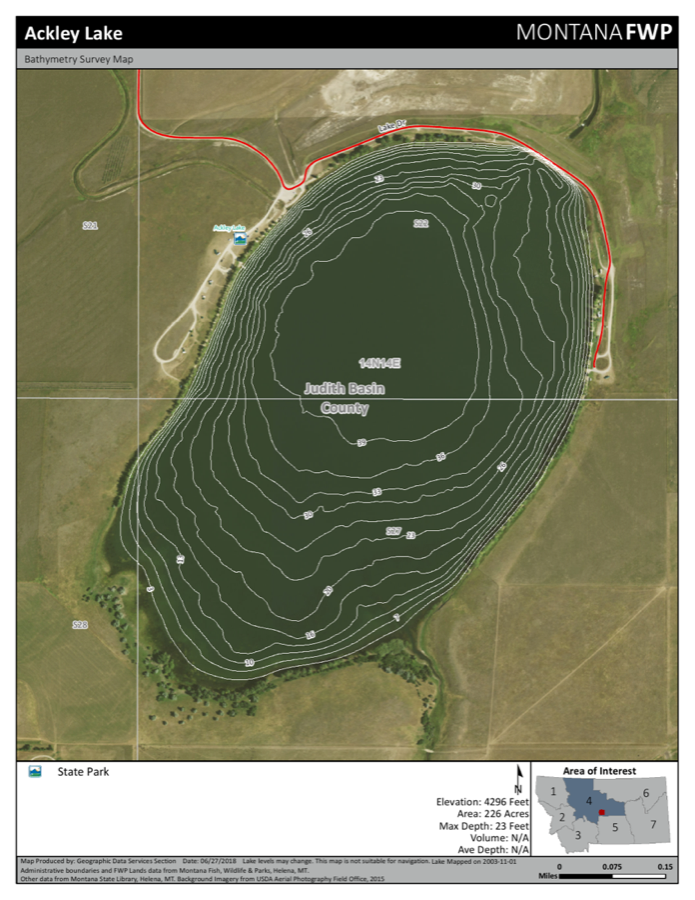
Bathymetric depth chart — click to open the full PDF. Source: Vermont DEC.
Source: Vermont DEC
Water Characteristics
Ackley is a shallow prairie impoundment: 226 surface acres with a maximum depth of only 23 feet. The FWP bathymetric chart shows a compact basin with the deepest water held in the old creek channel toward the dam, and broad, gently sloping shelves running out from most of the shoreline. There is no meaningful two-story structure here — the whole lake is within reach of a floating line and a long leader, and even the deepest holes are comfortably fishable with an intermediate.
Because the lake is shallow and sits in open, sunny country at 4,296 feet, it warms quickly in spring and can stratify only weakly and briefly in midsummer. Productive prairie water means moderate rather than gin-clear visibility, with the clarity typically best at ice-out and after fall cooling and poorest during warm, algae-rich stretches in July and August. Wind is a constant factor: the Judith Basin offers little shelter, and a stiff breeze can build a real chop across the whole lake in short order.
The food web is classic shallow-stillwater. Chironomids are the backbone, emerging in quantity from the silty flats from ice-out onward, and Callibaetis provide the main surface show once the water warms. Damselflies and dragonflies use the shallow weedy margins, and leeches are abundant along the drop-off edges — which is why a black or olive Woolly Bugger is never a bad first choice here.
Stocking
| Species | Size | Number | Program |
|---|---|---|---|
| Rainbow Trout (Eagle Lake strain) | 2.8 in fingerling | 10,300 | Montana FWP 2026 plant |
| Rainbow Trout (Arlee strain) | 4.2 in fingerling | 14,670 | Montana FWP 2026 plant |
| Rainbow Trout (Arlee x Erwin-Ennis) | Catchables to 8 in | Count not published | Montana FWP 2024 plant |
Seasonal Fishing Guide
Spring
The prime window. From ice-out through June the entire 23-foot basin is fly water. Start with chironomid pupae under an indicator over 8-15 feet along the shelf edges, and switch to a slowly stripped leech or black Woolly Bugger on an intermediate line when the wind builds. The first Callibaetis appear as surface temperatures climb through the fifties, and cruising rainbows in the shallow margins will take a Parachute Adams fished to a visible fish.
Summer
Shallow prairie water warms fast, so compress your day into first and last light. Callibaetis emergences give the best dry-fly opportunity of the year in June and early July, and damselfly migrations along the weedy margins are worth a damsel nymph fished on a slow hand-twist retrieve. Through the hottest weeks work the deeper channel edges near the dam with buggers, and expect afternoons to be slow.
Fall
September and October are the second peak. Cooling water pulls rainbows back into the shallows to feed before winter, and streamer-style fishing gets aggressive: strip Woolly Buggers, leeches, and Egg-Sucking Leeches along the drop-offs on an intermediate line. Late chironomid activity continues on calm days, and pressure drops to nothing once the campground empties out.
Winter
The reservoir freezes and open-water fly fishing ends. Winter effort is local and light, and no specialized ice fishery is documented here. Check current Montana season rules and ice conditions before any winter trip, and plan your fly fishing for the ice-out window instead.
Access & Boats
Ackley Lake State Park surrounds the reservoir and provides the primary public access, with boat ramps and campsites directly on the water. The park is reached from the Hobson area southwest of Lewistown, and the layout makes launching a boat, canoe, or float tube straightforward. Because the lake is small and shallow, a float tube or pontoon is arguably the ideal craft: it lets you cover the shoreline shelves and drop-offs quietly without needing to trailer anything. Shoreline access is easy and largely unobstructed, and bank anglers can reach productive water from the developed park frontage. Camping on site makes it practical to fish the dawn and dusk windows that matter most in summer.
Ice Fishing
Central Montana winters lock up a lake this shallow reliably, and the state park access remains the entry point for winter anglers. No specialized ice fishery is documented for Ackley in state materials, and the winter effort here is local and modest rather than a destination draw. Montana's district regulations govern winter fishing on the lake; confirm current season dates, any winter-specific rules, and — always — ice thickness locally before heading out.
Fishing Pressure & Local Tips
Moderate overall but very light from fly anglers. The state park campground and boat ramps keep a steady flow of family, bait, and spin traffic on the water through summer weekends and holidays, and the lake is a well-known local recreation spot for the Lewistown and Judith Basin area. Fly-specific pressure is close to nonexistent — chironomid and Callibaetis fishing that would draw a crowd elsewhere in Montana goes almost unfished here. Weekday mornings in May and October are frequently solitary, and even in July an early start usually means having the shallows to yourself before the recreational boats appear.
Local Knowledge
Fish the chironomid game seriously here — it is the single most productive approach on the lake and almost nobody uses it. Anchor or stake out over 8 to 15 feet of water off a shelf edge, hang a Chironomid Bomber or Zebra Midge a foot or two off the bottom under an indicator, and be patient. The rainbows patrol these flats on predictable beats, and once you find a working depth you can repeat it around the lake.
When the wind comes up, use it rather than hiding from it. A chop on a shallow prairie reservoir pushes food and disoriented insects against the downwind shore, and the trout follow. Drift a float tube along the wind-blown bank with a leech or black Woolly Bugger on an intermediate line and cover water; on a windy May afternoon this often outproduces the calm-water technical approach.
Watch the calendar rather than the fish. Ackley's shallow basin means the good fishing is front-loaded and back-loaded: ice-out through late June, then again from early September through freeze-up. Midsummer is not hopeless, but plan those trips around first and last light and expect to work deeper edges. And because stocking is heavy and annual, a lake that fished slowly one year is worth a second look the next.
Species Present
Food Sources & Hatches
| Insect | Suggested Fly | Jan | Feb | Mar | Apr | May | Jun | Jul | Aug | Sep | Oct | Nov | Dec |
|---|---|---|---|---|---|---|---|---|---|---|---|---|---|
Chironomids (midge pupae) Morning through early afternoon; strongest on calm, overcast days | Chironomid (Bomber) | ||||||||||||
Chironomid emergers and adults Dawn and again in the evening on flat water | Zebra Midge | ||||||||||||
Callibaetis Late morning to mid-afternoon | Parachute Adams | ||||||||||||
Damselfly nymphs Mid-morning through afternoon | Damselfly Nymph | ||||||||||||
Dragonfly nymphs All day | Dragonfly Nymph | ||||||||||||
Leeches All day; best at dawn, dusk, and in wind-driven chop | Woolly Bugger | ||||||||||||
Midge clusters Calm evenings and early mornings | Griffith's Gnat |
Chironomids (midge pupae): The backbone of the fishery. Emergences begin at ice-out and continue in waves all season from the silty flats. Fish pupae under an indicator 12-24 inches off the bottom over 8-15 feet along shelf edges.
Chironomid emergers and adults: A Zebra Midge fished a foot above a heavier pupa pattern doubles your coverage of the emergence column. On glassy evenings trout will dimple on adults and clusters in the shallow margins.
Callibaetis: The main dry-fly show. Duns emerge over the shallow flats once water temperatures climb, and cruising rainbows work them in visible feeding lanes. Sight-fish to individual risers rather than blind casting.
Damselfly nymphs: Migrating nymphs swim toward shoreline vegetation in early summer. Fish an olive damsel nymph on a floating or intermediate line with a slow hand-twist retrieve parallel to the weedy margins.
Dragonfly nymphs: Large, year-round residents of the shallow weedbeds and a reliable searching pattern when nothing is showing. Crawl or short-strip a big nymph along the bottom near the drop-off edges.
Leeches: Abundant along the drop-off edges and the single most dependable searching fly on the lake. Black and olive in size 8-10 on an intermediate line covers water fast when the wind is up.
Midge clusters: On flat-calm evenings trout sip clustered adults in the shallow margins. A Griffith's Gnat fished on a fine tippet to a rising fish is the finishing move on a summer session.
Recommended Flies
Chironomid (Bomber)
Top PickThe essential Ackley fly. Fish under an indicator 12-24 inches off the bottom over 8-15 feet along the shelf edges; black, red, and olive all produce. Almost nobody fishes chironomids here, and the trout show it.
Best in Spring through Fall
Zebra Midge
Top PickSizes 16-18 as a dropper above a heavier pupa, or fished alone in the top few feet during a strong emergence. Simple, cheap, and deadly on stocked rainbows.
Best in Spring through Fall
Woolly Bugger
Top PickOlive or black in size 8-10 on an intermediate line, stripped along the drop-offs. The best searching fly on the lake when the wind is up or the fish aren't showing.
Best in Spring and Fall
Parachute Adams
Top PickSizes 14-16 for the Callibaetis emergence. Sight-cast to individual cruising fish over the shallow flats between late morning and mid-afternoon.
Best in Summer
Access Points & Boat Launches
Ackley Lake State Park Boat Ramp
Boat LaunchEasyPrimary developed launch inside Ackley Lake State Park, serving boats, canoes, kayaks, and float tubes. The short run to any part of the 226-acre reservoir makes this the practical starting point for nearly every trip.
Ackley Lake State Park Campground Shoreline
Wade AccessEasyOpen shoreline frontage along the state park campground with easy walk-in access to the shallow margins. Good bank casting and the natural launch point for float tubes; camping on site makes the dawn and dusk windows practical.
Dam End Shoreline Access
Wade AccessEasyWalk-in shoreline near the deeper end of the reservoir where the old creek channel holds the lake's maximum depth. The steepest drop-off in the lake sits within casting range here, making it the best bank spot for leech and bugger work in midsummer and fall.
Regulations
Regulations
Ackley Lake is managed under Montana's standard Central District trout regulations — no special restrictive rules are published for the lake, and general statewide season and limit provisions apply. A Montana fishing license is required, and Ackley Lake State Park may charge day-use or camping fees. Regulations, limits, and district boundaries change; verify current rules at myfwp.mt.gov before you fish.
Always verify current regulations with Montana Fish, Wildlife & Parks before fishing.
Quick Facts
- Surface Area
- 226 acres
- Max Depth
- 23 ft
- Elevation
- 4,296 ft
- Lake Type
- Reservoir
- Region
- Central Montana / Judith Basin County
- Best Seasons
- spring, fall
- Species
- Rainbow Trout
- Difficulty
- Beginner-Intermediate
- Depth Chart
- Download PDF
Nearby Lakes & Ponds
Georgetown Lake
Southwest Montana / Anaconda-Pintler; Deer Lodge and Granite Counties
Hebgen Lake
Southwest Montana / Madison Valley; Gallatin County
Clark Canyon Reservoir
Southwest Montana / Beaverhead Valley; Beaverhead County
Browns Lake
Western Montana / Blackfoot Valley; Powell County
Dailey Lake
South-central Montana / Paradise Valley; Park County
Canyon Ferry Lake
West-central Montana / Missouri River; Broadwater and Lewis and Clark counties