Mountain Whitefish
Prosopium williamsoni
Overview
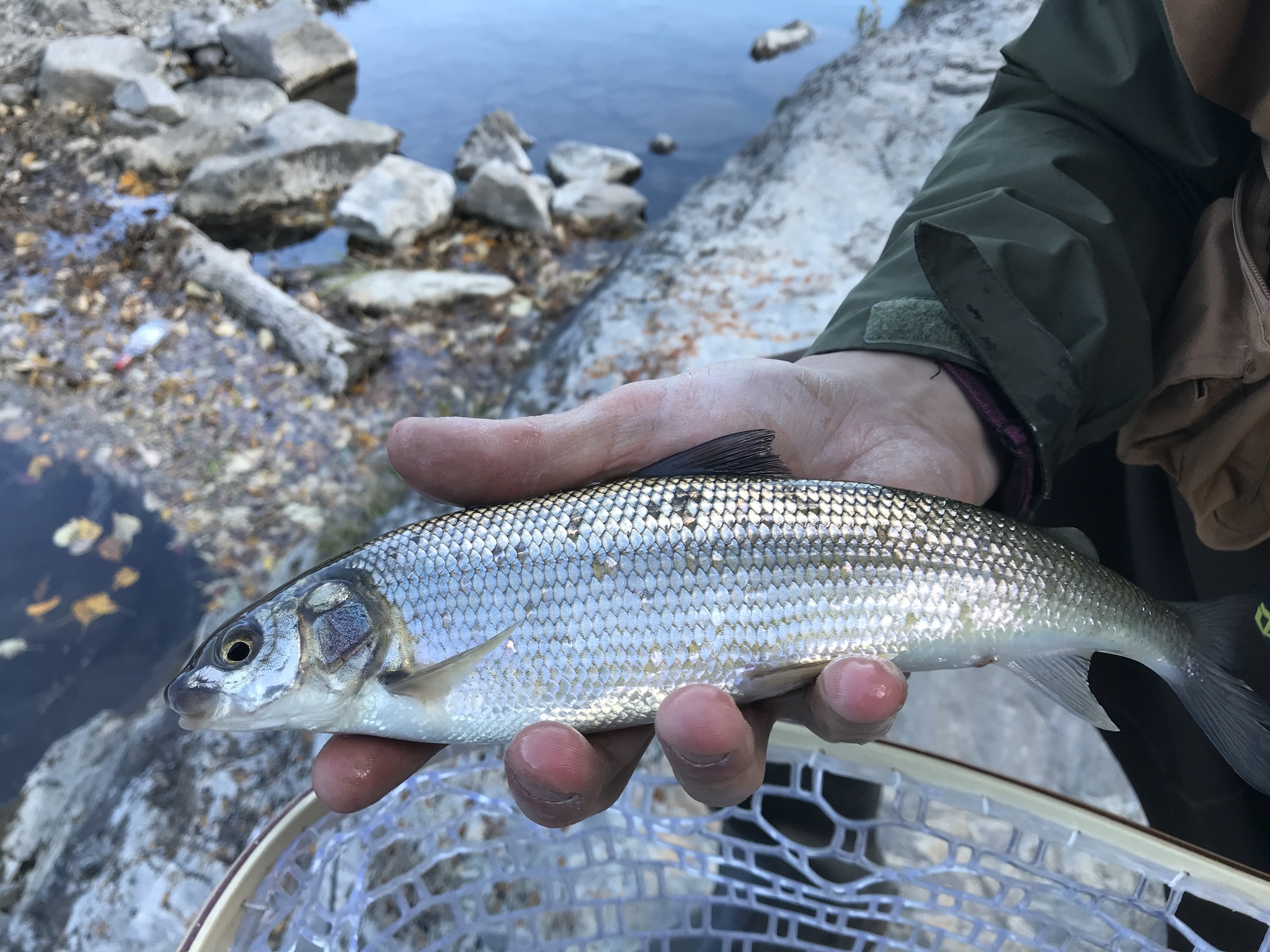
The mountain whitefish is one of Montana's most abundant native salmonids and arguably the most underappreciated gamefish in the state. A member of the whitefish subfamily (Coregoninae) within the broader salmonid family, mountain whitefish are present in virtually every cold-water river and large stream in Montana, often outnumbering trout by significant margins. On rivers like the Madison, Gallatin, Yellowstone, and Bitterroot, whitefish populations can exceed 1,000 fish per mile, making them the dominant salmonid species by biomass in many reaches. Despite this abundance, most fly anglers overlook whitefish entirely or view them as an unwelcome catch, which is unfortunate because they can provide outstanding sport on light tackle.
Mountain whitefish are an important ecological component of Montana's river systems. They serve as a primary food source for larger brown trout, bald eagles, ospreys, otters, and other predators. Their fall spawning behavior (typically October through December) plays a critical role in nutrient cycling, and their eggs provide food for other fish and aquatic invertebrates during the lean winter months. In recent years, whitefish populations have been used as indicator species for overall river health, and declines in whitefish numbers on some Montana rivers have raised concerns about changing water conditions and disease pressure.
For anglers willing to target them intentionally, mountain whitefish offer several advantages. They feed actively throughout the winter months when trout fishing can be slow, they are abundant and widely distributed, and they fight with surprising strength for their size; a 16-inch whitefish on a 3- or 4-weight rod provides a memorable tussle. Whitefish are also excellent table fare, with firm, mild-flavored white flesh that is delicious smoked or fried. Montana regulations typically allow a generous harvest limit for whitefish, recognizing their abundance and the role that harvest can play in managing populations on some waters.
Identification
Mountain whitefish are easy to distinguish from trout once you know what to look for. Their most obvious feature is the small, rounded, subterminal mouth, positioned on the underside of the head rather than at the tip of the snout, which reflects their bottom-feeding lifestyle. This small mouth is markedly different from the large, toothy gape of a trout and is the single quickest identification feature. The head is relatively small and pointed, with a slightly overhanging snout.
The body of a mountain whitefish is elongated and cylindrical, with large, silvery scales that are much more visible than the tiny, embedded scales of trout. The overall coloration is silvery to olive-bronze on the back, shading to white or silver on the sides and belly, without the spots, slashes, or colorful markings that characterize Montana's trout species. The dorsal fin is tall and sail-like, and the adipose fin (the small, fleshy fin between the dorsal and tail) is present, confirming the fish's membership in the salmonid family.
Mountain whitefish are sometimes confused with lake whitefish (Coregonus clupeaformis) or pygmy whitefish (Prosopium coulterii), both of which occur in some Montana waters. Mountain whitefish are generally larger and more elongated than pygmy whitefish and are found in rivers rather than exclusively in lakes. They can also be distinguished from suckers (which share a similar subterminal mouth) by the presence of the adipose fin and their smaller, less fleshy lips. When caught, whitefish often feel noticeably softer and more slippery than trout, reflecting their larger, more prominent scales.
Diet
Mountain whitefish are primarily bottom feeders, using their small, subterminal (downward-facing) mouths to pick insect larvae and other invertebrates off the streambed. Their diet consists heavily of aquatic insect nymphs and larvae, including mayfly nymphs (Baetis, Ephemerella, Epeorus), caddis larvae, midge larvae and pupae, and small stonefly nymphs. Unlike trout, which actively position themselves in the current to intercept drifting food, whitefish tend to forage directly on the bottom substrate, nosing through gravel and cobble for food items.
Despite their bottom-feeding tendencies, mountain whitefish will readily feed on the surface during heavy insect hatches, particularly during caddis emergences and midge hatches. On the Madison and Gallatin rivers in summer, whitefish can often be seen rising alongside trout during evening caddis hatches, slashing at adult insects with their distinctive small-mouthed rises. During winter, whitefish feed almost exclusively on midges and small mayfly nymphs, and they are often the most active fish in the river when water temperatures drop below 40 degrees Fahrenheit.
Fish eggs, small crustaceans, and aquatic worms supplement the whitefish diet at various times of year. During the fall trout spawning season, whitefish will position themselves downstream of brown trout redds to intercept dislodged eggs, a behavior that anglers can exploit with egg patterns and small, bright nymphs. Whitefish are less likely than trout to eat large food items like minnows, crayfish, or streamers, though occasional exceptions do occur with larger individuals.
Habitat Preferences
Mountain whitefish prefer cold, clean rivers and large streams with water temperatures between 45 and 60 degrees Fahrenheit. They are most abundant in medium- to large-sized rivers with moderate current, clean gravel and cobble substrate, and good water clarity. In Montana, prime whitefish habitat includes the mainstem Madison, Gallatin, Yellowstone, Missouri, Flathead, and Bitterroot rivers and their larger tributaries. Whitefish generally avoid the smallest headwater streams that brook trout favor, instead occupying mid-river to lower-river habitats.
Within a river, whitefish tend to school in deeper runs, pools, and glides with moderate current, the kind of water that is easy to wade and pleasant to fish. They hold closer to the bottom than trout and often stack up in large pods, meaning that when you find one whitefish, there are usually dozens more nearby. This schooling behavior is most pronounced in winter, when hundreds of whitefish may congregate in the deepest, slowest pools in a river reach to conserve energy during cold weather.
Mountain whitefish spawn in the fall, typically from mid-October through early December, over clean gravel in riffles and shallow runs. Unlike trout, they do not construct redds (nests) but instead broadcast their eggs over the gravel substrate, where the eggs settle into crevices between rocks. This spawning strategy means whitefish are somewhat less dependent on specific gravel quality than trout, but they still require clean, unsilted substrate for successful reproduction. Some biologists have noted that whitefish populations are sensitive to heavy metal contamination and have used whitefish health as an indicator of overall water quality in mining-impacted watersheds.
Fishing Tactics
Nymph fishing is the most effective method for targeting mountain whitefish. Because of their small, bottom-oriented mouths, whitefish feed primarily on nymphs and larvae picked off the streambed, and your flies need to be drifted right along the bottom to consistently connect. A standard two-nymph rig under a strike indicator works well, with small, heavy patterns like beadhead Pheasant Tails, RS2s, Rainbow Warriors, and copper-bodied midges in sizes 16 through 20. Use enough split shot or tungsten weight to keep the flies ticking along the bottom; if you are not occasionally bumping rocks, you are probably fishing too high in the water column.
During winter months (December through March), mountain whitefish provide some of the best nymph-fishing action available in Montana. While trout can be sluggish and difficult in cold water, whitefish remain actively feeding on midges and small mayfly nymphs throughout the winter. Focus on deeper, slower pools and runs where whitefish congregate during cold weather, and scale down your tackle: a 3- or 4-weight rod, long fine leader, and tiny midge patterns (size 18-22) are ideal. Winter whitefish fishing is an excellent way to stay sharp and keep casting during the off-season months.
Whitefish will also rise to dry flies during insect hatches, particularly caddis and midge emergences. Their small mouths make them difficult to hook on the surface (expect plenty of missed strikes), but this challenge is part of the fun. Small elk hair caddis (size 16-18) and Griffith's Gnats (size 18-22) are effective patterns during surface-feeding episodes. For a productive and entertaining approach, try a dry-dropper rig with a small, visible dry fly on top and a tiny nymph trailing below. This setup lets you fish both the surface and the bottom simultaneously, covering whitefish feeding at all levels of the water column.
Conservation
Native and generally stable across Montana, though localized population declines have been documented on some rivers. Whitefish die-offs linked to proliferative kidney disease and other pathogens have occurred on several Montana rivers in recent years, raising monitoring concerns. Mountain whitefish are not listed as a species of special concern but are recognized as an important native species and ecological indicator.
Rivers Where Found
Madison River
Southwest Montana
Yellowstone River
South Central Montana
Gallatin River
Southwest Montana
Missouri River
Central Montana
Colorado River
Grand County / Northern Mountains
Frying Pan River
Roaring Fork Valley / Central Mountains
Gunnison River
Western Slope / Black Canyon Country
North Platte River
Central Wyoming
Snake River
Northwest Wyoming / Jackson Hole
Henry's Fork
Eastern Idaho
South Fork Snake River
Eastern Idaho
Salmon River
Central Idaho
South Fork Boise River
Southwestern Idaho
Deschutes River
Central Oregon
Crooked River
Central Oregon
Metolius River
Central Oregon (Cascades)
McKenzie River
Willamette Valley / Cascades
John Day River
Eastern Oregon (High Desert / Blue Mountains)
Owyhee River
Southeastern Oregon
Yakima River
Central Washington
Methow River
North Central Washington, Okanogan County
Skagit River
Northwest Washington, Skagit County
Klickitat River
South Central Washington, Klickitat County
Truckee River
Eastern Sierra / Nevada and Placer Counties
Truckee River
Western Nevada / Washoe County
East Walker River
Western Nevada / Lyon County
Quick Facts
- Scientific Name
- Prosopium williamsoni
- Average Size
- 12-16"
- Trophy Size
- 20+"
- State Record
- 5 lbs 8 oz, caught in the Flathead River by Don Barth in 1983
- Found In
- Madison River, Yellowstone River, Gallatin River, Missouri River, Colorado River, Frying Pan River, Gunnison River, North Platte River, Snake River, Henry's Fork, South Fork Snake River, Salmon River, South Fork Boise River, Deschutes River, Crooked River, Metolius River, McKenzie River, John Day River, Owyhee River, Yakima River, Methow River, Skagit River, Klickitat River, Truckee River, Truckee River, East Walker River